Saturday, May 3, 2014

Lancia Flavia, 2013

Lancia Flavia, 2013, Luxury Automobiles Lancia Flavia, 2013, Luxury Automobiles
 Lancia Flavia, 2013, Luxury Automobiles Lancia Flavia, 2013, Luxury Automobiles
 Lancia Flavia, 2013, Luxury Automobiles Lancia Flavia, 2013, Luxury Automobiles
 Lancia Flavia, 2013

With its free and sophisticated spirit, the new Lancia Flavia proves it is the quintessence of open air driving pleasure with 4 genuine seats. It is the ideal answer for a customer who wants the advantages of a coupé without sacrificing the unique sensations that only a convertible has to offer. That's not all. The new convertible is the most interesting option of this market segment able to win over a customer who demands not only a substantial product, but also a distinctive and unique style. Besides, whoever chooses a Lancia vehicle starts a new trend because he follows only his own personality.

It is the perfect expression of the Italian way of life, the beauty of Italian lifestyle based on taste, imagination, style and refinement. The new front wheel drive Lancia Flavia guarantees a refined driving experience unparalleled by any other in its segment, whether tackling the daily trip in town to go to the office or when taking to splendid panoramic roads out of town on weekends.

In terms of length (4.9 metres), height (1.4 m) and width (1.8 m), the new Lancia is at the top of segment D, offering the ultimate in interior room (it can perfectly accommodate up to four adults) and on-board comfort, with its generous 276-cm wheelbase.

Distinguished by an elegant and dynamic look, Lancia Flavia has a sculpturesque front end sporting the unprecedented grille with Lancia logo and the original front headlights and fog lights. Furthermore, the surface of the side panel is extremely clean, in addition to being distinguished by a sleek line, which lengthens the car and lends it dynamism, and by elegant 18" alloy wheels.

The rear LED light clusters stylistically connected by a thin chrome-plated bar that further enhances their overall look contribute to accentuating the original design. This impression is further reinforced by the unusual chrome-plated tailpipe and by the sophisticated electrically-controlled soft top enclosed inside the hood cover, harmoniously built into the body with the third brake light at its base.

The "elegance and dynamism" describe the exterior of the new Flavia, the guidelines inside are refinement and innovation, in perfect tune with the Italian style and the craftsmanship quality that has always distinguished Lancia cars. Aesthetic refinement that flows through the entire passenger compartment and wraps around driver and passengers in a warm "embrace" thanks to the careful selection of fine materials, the attention devoted to the smallest detail and the adoption of cutting-edge comfort, safety and driving pleasure content.

Therefore, the new Lancia Flavia boasts a sophisticated environment that will without a doubt win over a customer who seeks exclusiveness, technology and Italian taste in a car. A new console has been created for him. It has elegant chrome-plated frames and a large central display; a brand new steering wheel wrapped in leather complete with built-in controls for managing radio, cruise control and phone in total safety; and newly designed seats upholstered in fine leather, complete with practical "active" headrests.

Produced at the Sterling Heights plant in Michigan (USA), in keeping with the stylistic features of the Lancia brand, the glamorous Lancia Flavia Cabrio interprets the Chrysler 200 Convertible model being launched on the European market. In Italy Lancia Flavia is offered in a single, exclusive version that is "all inclusive". As the name itself intimates, it offers a wealth of standard equipment, from the top quality leather upholstery, electronic stability control (ESC) and traction, latest-generation ABS and four airbags (front multi-stage and side) to the ISOFIX mountings for transporting children in complete safety, the innovative Uconnect® multimedia system complete with satellite navigation system, and the sophisticated "Boston Acoustic Sound System".

The new Lancia Flavia is equipped with a 2.4 litre petrol engine combined with a 6-speed automatic transmission that delivers a maximum power of 170 HP at 6000 rpm and a maximum torque of 220 Nm at 4500 rpm.

Lancia Flavia completes one of the broadest ranges on the international automotive scene
The Lancia Flavia launch completes the Lancia range in an important year, which began with the new 5-door Ypsilon marketing and continued with the debut of the flagship Thema and the best Voyager ever. These latter two cars - together with the brand-new Lancia Flavia that, in keeping with the stylistic features of the Lancia brand, interprets the Chrysler 200 Convertible model being launched on the European market - are the best demonstration of how it is possible to join two worlds so geographically distant yet so close in their essence. This perfect alchemy expertly combines typically American dimensions, personality and performance with the interior elegance, comfort and exclusivity of great Lancias.

The result is a new automotive dynasty founded on the will to excel in the future and on the values engraved in its century-old history: design and innovation. Without forgetting the Delta and Musa models that complete one of the widest ranges on the international scene that starts with segment B to reach the Large MPV segment, also including the medium, flagship and convertible segments.

Style: elegance on the outside, refinement on the inside
Superior in design, aerodynamic in forms and sinuous between the folds of the wind. The new Flavia boasts an unconventional beauty that combines elegance on the outside and innovation on the inside, in perfect tune with the Italian style and the craftsmanship quality that has always distinguished Lancia cars.

Elegant and dynamic look embellished with a next-generation soft top
Distinguished by an elegant and dynamic look, Lancia Flavia has a sculpturesque front end sporting the unprecedented grille with Lancia logo and the original front headlights and fog lights. Furthermore, the surface of the side panel is extremely clean, in addition to being distinguished by a sleek line, which lengthens the car and lends it dynamism, and by elegant 18" alloy wheels.

The rear LED light clusters stylistically connected by a thin chrome-plated bar that further enhances their overall look contribute to accentuating the original design. This impression is further reinforced by the unusual chrome-plated tailpipe and by the sophisticated electrically controlled black soft top enclosed within the soft top cover, harmoniously built into the body with the third brake light at its base.

The exterior colours available at launch are Bright White and Mineral Grey, which can be matched with two interior shades - black and two-tone black and white - and one soft top colour, black. Afterwards the colour range of Lancia Flavia enriched with the Deep Cherry, Silver, Black and Blackberry body colours in addition to a beige soft top.

Read More

Lamborghini Huracan LP610-4, 2015

Lamborghini Huracan LP610-4, 2015, Luxury Automobiles
 Lamborghini Huracan LP610-4, 2015, Luxury Automobiles Lamborghini Huracan LP610-4, 2015, Luxury Automobiles
 Lamborghini Huracan LP610-4, 2015, Luxury Automobiles Lamborghini Huracan LP610-4, 2015, Luxury Automobiles
 Lamborghini Huracan LP610-4, 2015, Luxury Automobiles Lamborghini Huracan LP610-4, 2015, Luxury Automobiles
 Lamborghini Huracan LP610-4, 2015

Automobili Lamborghini is taking a major step into the future: with the newly developed Lamborghini Huracán LP 610-4, the successor to the highly successful Gallardo, the Italian super sports car manufacturer is redefining the benchmark in the segment. With its pure and absolute design, breathtaking dynamics and excellent quality, the Huracán delivers an unparalleled sports car experience. It unites mighty performance with a character perfectly suited to everyday use; its wide-ranging new technologies work together in a fully integrated fashion. Stephan Winkelmann, President and CEO of Automobili Lamborghini said: "With the Huracán, Lamborghini is writing the next chapter in its great history."

With 14,022 units produced, the Gallardo is the most successful Lamborghini model ever made. During its ten-year production run, it took the brand into a completely new dimension. In true Lamborghini tradition, the successor to the Gallardo also takes its name from the world of bullfighting: Huracán was a fighting bull of the Spanish Conte de la Patilla breed who fought in August 1879 in Alicante. His unyielding character made him invincible.

With the Lamborghini Huracán LP 610-4, Lamborghini is taking its purist, unmistakable design language to a whole new evolutionary level. The design is bold and edgy, with beautifully sculptural forms. The starting point of the design process was the Huracán's silhouette. The objective was to define the car with a single line stretching from the front end over the passenger cell to the rear. The side windows take on a hexagonal form that looks like a gem set into the profile of the Huracán. At night, too, it is utterly unmistakable: All lights, including the main headlamps, beam in LED technology - an absolute first in the super sports car segment.

An innovative cockpit dominates the interior. The 12.3-inch TFT display can be configured in a number of different modes and provides the driver with all key information in a virtual format. The slender lines of the instrument mounts and the center tunnel are indicative of the lightness of the interior design. Fine materials distinguish the interior, which can be extensively individualized, while the extremely detailed craftsmanship delivers a highly refined sense of quality.

The newly conceived hybrid chassis of the Huracán LP 610-4 is a technical work of art that unites carbon-fiber and aluminum components. The ultralight chassis forms the basis for the vehicle's low dry weight of 1,422 kilograms; with its excellent stiffness, it guarantees the handling precision of a racing car.

The new V10 engine in the Huracán generates its phenomenal propulsion from a displacement of 5.2 liters. It produces a power output of 448 kW / 610 hp at 8,250 rpm and a maximum torque of 560 Nm at 6,500 rpm. The new "Iniezione Diretta Stratificata" combines direct and indirect injection - achieving an increase in power and torque compared with the Gallardo and a decrease in fuel consumption and emissions.

With its power-to-weight ratio of just 2.33 kilograms per hp, the Lamborghini Huracán achieves absolutely breathtaking performance. The top speed of more than 325 km/h and the acceleration figures - zero to 100 km/h in 3.2 seconds, zero to 200 km/h in 9.9 seconds - offer an indication of its dynamics. Thanks in part to the Stop & Start technology, ECE average fuel consumption has dropped to 12.5 liters per 100 km (290 g CO2 per km).

The power generated by the ten-cylinder is delivered to the road via the new 7-speed dual-clutch transmission "Lamborghini Doppia Frizione" (LDF) and an all-wheel drive that also features a new hydraulic multi-plate clutch. Three different driving modes, spanning from road to race track, can be selected using a drive select switch in the steering wheel. The system is called ANIMA (Italian for Soul) - "Adaptive Network Intelligent Management", and impacts the engine, the transmission, the all-wheel drive and the ESC handling system as well as other dynamic systems.

The wheels of the Lamborghini Huracán measure 20 inches in diameter, with the standard-fit carbon-ceramic brake system delivering exceptional stopping power. As an option, Lamborghini offers its new luxury super sports car with the Lamborghini Dynamic Steering variable steering system and MagneRide electromagnetic damper control. Both of these features are also integrated into ANIMA.

The Lamborghini Huracán LP 610-4 celebrates its show premiere at the 2014 Geneva Motor Show, with customer delivery scheduled to start in spring 2014. The Huracán is priced at 169,500.00 Euro, excluding taxes. The Production takes place at Automobili Lamborghini headquarters in sant'Agata Bolognese.

Exterior Design
The elegance of a Lamborghini is in the beauty of its highly concentrated power - every line and every detail pursues the need for speed, dynamics, performance. Design is an essential element of the Huracán LP 610-4, too - unmistakable, hermetically sealed and completely free from ornamentation.

The dimensions frame the contours of a dynamic wedge measuring 4,459 mm long, 1,924 mm wide and 1,165 mm high, with a wheelbase of 2,620 mm. Taut curves contrast with sharp edges, which require innovative technology in working with aluminum and carbon fiber and with geometric surfaces. A characteristic basic form for Lamborghini is the hexagon - visible in the front air intakes and their three-dimensionally formed mesh inserts, in the side windows, in the intake openings for the engine and in the standard-fit wheels in Giano design.

The arrow-shaped front end of the Lamborghini Huracán angles sharply downward like the nose of a shark, with two pleats adding contour to the hood. The flat, angular headlamps are fitted only with LEDs - an innovation in this class of super sports car. Light guides produce the daytime running light, forming two Y-shaped contours in each headlamp and giving the Huracán the look of a predator ready to pounce. With a color temperature of 5,500 Kelvin, the LED light is very close to that of daylight, providing excellent road illumination and putting very little stress on the eyes. The LEDs are designed to last the lifetime of the vehicle and are extremely energy efficient.

A massive air intake, cut deep into the front end and stretching across its full width, dominates the front of the Huracán. Fins painted in body color cut strong diagonal lines through it. As on a race car, the lower contours of the air intake jut forward to form a splitter.

The avant-garde character of the Lamborghini design is particularly evident from the side - the Huracán LP 610-4 is a fast-moving technical sculpture.

Its aluminum cladding stretches tautly over the mighty 20-inch wheels; a single, flowing line runs from the front end over the roof to the rear. The roof arcs slightly over the heads of the driver and co-driver, these contours continuing onto the luggage compartment lid and through the extremely low-lying C-pillars.

Starting at the headlamp, is a line that runs over the front fender to define a broad, angled edge on the door. Together with the flat, dropping roof arc, the rising door edge presents a three-dimensional frame for the side windows - which are set into the flanks like gemstones. Where these lines meet at an acute angle is the upper intake that feeds the engine with air.

The lower intake for cooling air emerges from the angular sill in front of the wide, rear wheel arch. The absence of the large, vertical air intake that was a feature of the Gallardo, brings athletic tension and powerful flow to the flank of the Huracán.

In its standard format, the engine cover between the extremely low-lying C-pillars consists of three large, matte-black polymer fins in homage to the classic Miura. Lamborghini offers an optional transparent cover that reveals a clear view of the V10. In this version, the engine bay is clad in visible carbon fiber, made using Lamborghini's patented Forged Composite Technology.

The rear end of the Huracán also has a highly three-dimensional form. Like the intake at the front end, the wide, meshed outlet for ventilating the engine bay is cut deep into the rear. Above it are the narrow rear lights, likewise fitted entirely with LEDs. Similar to the front headlamps, their light also takes on a Y-shaped contour. The four end pipes of the exhaust system flank a large diffuser; its substantially dimensioned elliptical fairings are chromed and perforated.

Each design detail of the Lamborghini Huracán LP 610-4 celebrates the esthetic of function; the designers from the Centro Stile worked closely together with the aerodynamic experts. The large air intakes at the front of the super sports car specifically direct the cooling air and headwind to increase down pressure on the front axle. The spoiler lip at the rear works together with the rising diffuser in the underbody to improve airflow around the rear of the car - the Huracán does not require a movable rear spoiler. The underbody is completely clad, with NACA channels directing headwind to the radiators.
Read More

Koenigsegg One-1, 2014

Koenigsegg One-1, 2014, Luxury Automobiles Koenigsegg One-1, 2014, Luxury Automobiles
 Koenigsegg One-1, 2014, Luxury Automobiles
Koenigsegg One-1, 2014, Luxury Automobiles
 Koenigsegg One-1, 2014, Luxury Automobiles
Koenigsegg One-1, 2014

Koenigsegg is creating six uniquely developed and designed production cars - the One:1 program. This is one of the most exclusive production car program ever envisaged.

The hp to kg curb weight ratio is an astonishing 1:1. This is the "dream" equation previously thought impossible. On top of this the One:1 is the first homologated production car in the world with one Megawatt of power, thereby making it the world´s first series produced Megacar. These are the reason for naming the car One:1.

The 2014 One:1 truly raises the bar of performance. The One:1 features new and unique solutions to enhance track perfomance without compromising top speed or everyday usability, with a stunning visual appearance to go with it.

Examples of features; unique track optimized aero winglets, extended venturi tunnels and side splitters, Le-Mans inspired active wing configuration and optimized active undertrim air management. Large air vents for improved cooling, roof air scoop to support the 1 Megawatt of power. 8250 RPM rev limit, complimented with Custom made Michelin Cup Tires, upgrade rear triplex suspension with carbon bevel springs and active shockabsorbers and ride hight, combined with upgraded revolutionary Koenigsegg Aircore carbon fiber wheels.

Koenigsegg was the first extreme car manufacturer to take steps toward green technology with the release of the biofuel CCXR in 2007. The One:1, a sibling of the highly competitive Agera R, follows in the footsteps of the CCXR as it also runs on E85 biofuel, Racefuel or normal Petrol.

In order to give the One:1 maximum flexibility when it comes to power delivery, Koenigsegg has implemented its patented variable turbo geometry technology in the One:1 Program. This technology gives improved response and more low end torque than otherwise possible. As an example the One:1 engine has over 1000 Nm of torque between 3000 to 7500 rpm.
Read More

Friday, May 2, 2014

Kia Forte, 2014

Kia Forte, 2014, Luxury Automobiles
 Kia Forte, 2014, Luxury Automobiles Kia Forte, 2014, Luxury Automobiles
 Kia Forte, 2014, Luxury Automobiles Kia Forte, 2014, Luxury Automobiles
 Kia Forte, 2014

Pulling the silk off the all-new 2014 Kia Forte sedan at the 2012 Los Angeles International Auto Show, Kia Motors America (KMA) revealed a stunning European design-inspired sedan that makes it clear the Korean auto manufacturer has another winner in its line-up of sought-after cars and CUVs. Sitting on an all-new chassis that is longer, wider and lower than the previous-generation Forte, the all-new third-generation Kia Forte will offer more room, more performance and more premium amenities when it's expected to go on sale in the first quarter of 2013. The all-new 2014 Forte will be offered in LX and EX variants with a choice of an efficient 1.8-liter engine or a more powerful 2.0-liter engine.

Set to arrive at Kia retailers in early 2013, the all-new Forte will represent the heart of KMA's small-car line-up, replacing the current Forte, which has been a sales success story since launching in 2009. Slotted between the Rio sub-compact sedan and the best-selling Optima mid-size sedan, the all-new Kia Forte includes a raft of unexpected available premium features in a package that easily accommodates five passengers and their belongings.

Unexpected Premium Features
Offered in LX and EX trim levels, the all-new Forte proudly carries on Kia's reputation for offering premium features that redefine automotive segments. The LX model comes standard with steering wheel mounted audio controls, SiriusXM™ Satellite Radio, Bluetooth® wireless technology, power windows, air conditioning and power heated outside mirrors among the many features that make the Kia Forte stand out from its competition. The optional Popular Package adds 16-inch alloy wheels, cruise control, keyless entry with remote trunk release and a sliding front armrest. The Eco Package includes Kia's ISG (Idle Stop & Go) system, dual-zone automatic temperature control with rear seat ventilation and unique "eco" badge.

Stepping up to the EX trim broadens Forte's appeal with additional comfort and convenience features. Kia's next-generation UVO in-vehicle infotainment system with eServices is standard and can now be integrated with an optional navigation system. Additional standard EX features include remote keyless entry with trunk opener, rear camera back-up display, a sliding center armrest and a cooling glove box. The new optional Flex Steer system allows the driver to choose between three distinct steering profiles: Comfort, Normal and Sport. Features found in the optional Premium Package include heated front and rear seats, a 10-way power adjustable driver's seat with class-exclusive air-cooled ventilation, leather seat trim, power sunroof, 17-inch alloy wheels and push button start with Smart Key and a heated steering wheel. Opting for the Technology Package garners HID headlights, LED tail lights, a 4.2-inch color LCD cluster screen and dual-zone automatic temperature control with rear seat ventilation.

Enhanced Performance, Improved Ride and Handling
The all-new Kia Forte offers spirited performance thanks to two advanced four-cylinder engines. The LX features a 1.8-liter powerplant, while the EX comes standard with a 2.0-liter engine. Both engines feature dual continuously variable valve timing and a lightweight intake manifold that reduces weight by 30 percent over a cast unit. The aluminum "bed plate" located below the cylinder block reduces engine NVH levels and improves block rigidity by 30 percent.

With 148 horsepower available at 6,500 rpm and 131 lb.-ft. of torque on tap at 4,700 rpm, the 1.8-liter MPI inline four-cylinder engine found in the LX routes power to the front wheels through either a standard six speed manual transmission or an optional six speed automatic gearbox.

Kia Forte EX enhances the driving experience with a 173-horsepower (at 6,500 rpm) 2.0-liter inline four cylinder GDI engine. With a robust 154 lb.-ft. of torque available at 4,700 rpm, the EX comes standard with a six speed automatic.

The all-new Kia Forte rides on a chassis that is longer (by 1.2 inches), lower (0.6 inches) and wider (0.2 inches) than the previous Forte sedan. With its 106.3-inch wheelbase, two inches longer than the outgoing model, the all-new Forte rides on a McPherson strut front suspension and a coupled torsion beam rear axle. On-center steering feel is improved utilizing larger bushings and revised front suspension geometry. Electric power steering has replaced the hydraulic system from the previous Kia Forte, reducing parasitic load. Optional Flex Steer puts the driver firmly in control with settings for Comfort, Normal and Sport, which vary steering effort at the touch of a steering wheel-mounted button.

The base LX manual rides on 195/65R-15 tires, while 205/55R-16 tires on 16-inch alloy wheels are optional. The top-of-the-line EX is shod with the same 55-series tires. Low-profile 215/45-17 tires mounted on sporty 17-inch alloy wheels are optional.

Sport Sedan Design From California
With an aggressive stance, broad shoulders and a windshield rake that can only be described as sporty, the all-new Forte looks as good parked as it does carving through a remote canyon road. Influenced by European sport sedan styling, the Kia Forte's modern aesthetic was born in California at Kia's American Design Center in Irvine.

Dramatically swept headlight lenses cut deeply into the front fenders and incorporate projector headlamps. LED positioning lights create distinct eyebrows, making the Forte instantly recognizable in a crowd. Gentle sculpting along the Kia Forte's lower flanks taper the sheet metal inward, affording the car a taut, nimble appearance without diminishing its road presence. Around back, the up-kicked fender line and trunk design, with its deep horizontal crease, lend width and charisma while allowing the complex curves of the tail lights to flow over the rear haunches.
Read More

Jeep Cherokee EU-Version, 2014

Jeep Cherokee EU-Version, 2014, Luxury Automobiles
 Jeep Cherokee EU-Version, 2014, Luxury AutomobilesJeep Cherokee EU-Version, 2014, Luxury Automobiles
Jeep Cherokee EU-Version, 2014, Luxury Automobiles
 Jeep Cherokee EU-Version, 2014

The Jeep Cherokee is the mid-size Sport Utility Vehicle of the Jeep brand. In its fourth generation, the Cherokee has evolved into a completely new vehicle delivering to customers a fresh interpretation of the "Go anywhere, do anything" attitude of the legendary American brand. The new Jeep Cherokee powered by the efficient 2.0-liter Multijet II turbo diesel engine in combination with the new nine-speed automatic transmission is making its début at the 2014 Geneva International Motor Show.

The new Jeep Cherokee raises the bar in its segment and features a new sleek and athletic design, enhanced on-road driving dynamics and handling, legendary Jeep 4x4 capability, premium interior craftsmanship, innovative technology, new levels of efficiency, entertainment and comfort and 'five-star' safety and security features that recently allowed the vehicle to earn the 'best in class' designation from Euro NCAP in the Small Off-road 4X4 category.

Engineered to excel on any and all terrains, the new Jeep Cherokee expresses the synthesis between stylistic innovation and family tradition, legendary 4x4 capability and technology: features that are fully embodied in the new Limited model and in its alter ego, the 'off-road' specialist Trailhawk.

The new generation Jeep Cherokee is now available in both two-wheel drive and four-wheel drive configurations, offering a choice of three new and sophisticated Jeep four-wheel-drive systems in order to ensure benchmark off-road capabilities under all driving conditions. The new Jeep Cherokee is also the first mid-size SUV to feature rear-axle disconnect, resulting in reduced energy loss when 4x4 capability isn't needed and ensuring improved fuel efficiency. The rear-axle disconnect, seamlessly switches between two- and four-wheel drive for full-time torque management without requiring input from the driver.

The new Jeep Cherokee will be introduced in Jeep dealerships throughout Europe beginning the second quarter of 2014, in the Longitude, Limited and Trailhawk trim levels. The engine offer comprises the efficient 2.0-liter Multijet II turbo diesel delivering 170 horsepower. This engine will be matched with the new nine-speed automatic gearbox, which is used for the first time in the mid-size SUV segment. A 140 horsepower version of the 2.0-liter engine will also be available in combination with a six-speed manual transmission. The European lineup also includes the 3.2-liter V-6 Pentastar petrol engine paired to the new nine-speed automatic transmission. In Russia and the Middle East, a Sports trim level is available in the new Cherokee range and the new automatic gearbox is offered in combination with the 2.4-liter Tigershark MultiAir I-4.

The DESIGN
The new Jeep Cherokee boasts a cutting-edge, revolutionary design and features world-class craftsmanship and exclusive technological contents. Sleek and athletic exterior lines project the Jeep design into the future and convey efficiency and aerodynamics without compromising the brand's stylistic heritage.

Jeep designers were inspired to create a vehicle that remains true to the brand while moving it into the next era with a shape that is as efficient as the vehicle and ages gracefully without losing the DNA that makes it a Jeep. Fluid, sleek exterior lines highlight the efficient, wind-splitting upper body of the Cherokee. The rugged, protective lower body conveys the legendary capability that is characteristic of every Jeep.

The new Jeep Cherokee has a powerful stance, an aggressive wheel-to-body proportion and a commanding road presence. The approach and departure angles contribute to the best-in-class capability.

A key element in the front of the new Jeep Cherokee is the 'waterfall' hood with the iconic peaked, seven-slotted grille which includes a crisp, horizontal snap - a feature found in many classic Jeep vehicles. The hood is clearly defined and separated from the front fenders in a modern interpretation of the brand's design heritage. Advanced LED lighting technology is used throughout the new Jeep Cherokee. Daytime running lamps (DRL) and available Xenon headlights (standard on Limited in selected markets only), enhance the unique proportions of the front.

The sides feature the signature Jeep trapezoidal wheel arches. The rear is highlighted by the contemporary full LED tail lamps, which are an integral part of the rear backlight graphic, making the vehicle look stronger yet harmonious. This shape is the connection between the upper and lower rear as an interlocking graphic statement that brings a unique presence specific to this new Cherokee. The rear fascia also carries Jeep Cherokee-specific rear fog lamps and reflex.

The new Cherokee rides on 17-inch (Longitude and Trailhawk) or 18-inch tires (Limited) providing drivers with confident traction in snow and wet conditions.

Lastly, Jeep Cherokee offers customers the possibility to enjoy an open-air driving experience thanks to the new CommandView dual-pane power sunroof that is available as an option on all trim levels. CommandView extends from the windshield to the rear of the vehicle, allowing for perfect views both on- and off-road.

All-new, premium interior
The Jeep brand's recent Grand Cherokee introduction set the foundation for a new direction in interiors that the new Cherokee builds upon. The interior is modern, welcoming and comfortable. It features a sophisticated, refined design, hand-sculpted forms, signature Jeep styling cues, high-quality materials, precision craftsmanship and attention to detail. The cabin is designed to offer the driver ultimate comfort with useful, easy-to-operate technology and clever storage.

Also in the development of the Cherokee's all-new interior, Jeep designers took inspiration from the brand's heritage. The signature trapezoidal plan view feature line is classic Jeep, reminiscent of the trapezoidal wheel arches on the exterior. The center stack bezel is inspired by the outline of the front grille of the 1940s Willys Jeep and continues the design language of its larger sibling, the Grand Cherokee.

Premium materials abound wherever the customer touches the vehicle - the door uppers, the center armrest and the upper instrument panel. Throughout the cabin, customers will find interior trim that is soft to the touch and pleasing to the eye. A vinyl-wrapped, stitched instrument panel brow is standard on all models and the stitching carries over to the center console armrest and front door armrests.

The new Jeep Cherokee is available with three interior trim choices inspired from exotic locations and landscapes around the world, such as Morocco, Grand Canyon and the Italian Mount Vesuvio.

Seats are ergonomically designed to support the contour of the body, and are available with a 'memory' adjustable mechanism and heated/ventilated features for the front seats. They are trimmed with premium cloth (Longitude), quality Nappa leather (Limited and Trailhawk) or a combination of cloth and Nappa leather (Trailhawk).The 60/40 split second-row seats adjust fore and aft for increased passenger comfort and cargo flexibility.

Exclusive features such as the available heated, leather-wrapped steering wheel and wireless charging pad, complete the interior of the new Jeep Cherokee and will delight drivers and passengers alike.

Functionality is a main characteristic of the new Jeep Cherokee interior, where plenty of thoughtful, clever storage features can be found. A refined, covered, top bin is located above the center stack on top of the instrument panel for secured storage of small items. The front-passenger seat folds flat and offers hidden, in-seat storage by flipping up the passenger seat cushion.
Read More

Jaguar F-Type V8 S, 2014

Jaguar F-Type V8 S, 2014, Luxury Automobiles Jaguar F-Type V8 S, 2014, Luxury Automobiles
 Jaguar F-Type V8 S, 2014, Luxury Automobiles Jaguar F-Type V8 S, 2014, Luxury Automobiles
 Jaguar F-Type V8 S, 2014, Luxury Automobiles
Jaguar F-Type V8 S, 2014

The new Jaguar F-Type represents a return to the company's heart: a two-seat, convertible sports car focused on performance, agility and driver involvement. The F-Type is a continuation of a sporting bloodline that stretches back more than 75 years and encompasses some of the most beautiful, thrilling and desirable sports cars ever built. Joining the XK convertible and coupe models, the new F-Type provides Jaguar with a broader line of sports and GT models.

The 2014 Jaguar F-Type combines low vehicle weight (starting at 3,521 pounds), high power (340hp, 380hp and 495hp versions) and superb aerodynamics to achieve a pure sports car experience, yet with Jaguar elegance and luxury.

A true two-seat sports car, the all-new Jaguar F-Type is equipped with a modern, lightweight soft top that, when lowered, serves as its own tonneau cover. This not only provides a weight savings, but also improves packaging and contributes to the car's low center of gravity for greater agility. The top can be fully raised or lowered in just 12 seconds at speeds of up to 30 mph. Its multi-layer construction includes a Thinsulate lining for optimal thermal and sound-insulating properties.

The Exterior Design
Jaguar cars have always defined sinuous, muscular elegance, and the F-Type continues - and advances - this tradition with new, assertive design language. Two "heartlines" define, in just two bold strokes, both the profile and top-down view of the Jaguar F-Type. The main "heartline" theme begins in the blade dissecting the shark-like gills on either side of the grille. This first heartline runs up and forms the sharp top crease of the fender line, which provides sight lines that aid the driver in cornering maneuvers. It leads the eye along the top of the front fender, which is emphasized by the headlamp design, and then into the door and toward the rear of the car where it gracefully disappears.

The sweeping line is mirrored by the feature line that runs back from the side vent. Along with "lightcatcher" surface detailing above the sill, the line instills a sense of speed to the car. The lightcatcher surface detailing also allows the door surface to wrap around the side of the car, creating a fuselage effect.

The second "heartline" swells out to form the muscular rear haunch before sweeping dramatically around the rear of the car. The clean, sleek lines of the tail are made possible in part by the inclusion of an active rear spoiler that deploys at speed to reduce aerodynamic lift. The spoiler rises when the F-Type reaches 60 mph and then lowers to fit flush when the speed drops below 40 mph. Further discreet aerodynamic aids include a front splitter and a sculpted rear valance.

The headlights run vertically rather than horizontally, which leads the eye naturally up and along the fender crease. Technology has facilitated the design language of the Jaguar F-Type; the compact xenon unit requires just one projector, while the J-Blade LED running lights further emphasize the design of the heartline running through the lamp.

The grille leans slightly forward to create a suggestion of motion when the car is stationary. The lower edge of the clamshell hood forms the top of the side vent. The mesh in the grille and side vents is a hexagonal design that gives greater form and depth.

The hidden, automatically deploying door handles support the design purity. The handles remain flush with the door panel until activated by either unlocking the car with the key fob or touching a touch-sensitive area of the handle. Their automatic deployment provides a mechanical "handshake," inviting the driver and passenger to enter. Once the car is moving, the handles retract to leave an uninterrupted aerodynamic surface.

Full LED rear lamps create a new Jaguar sports car signature by reinterpreting classic cues from the past. By wrapping the lights around to the trailing edge of the rear wheel arch, the car's powerful rear-wheel drive stance is emphasized. Reflecting the way the front grille leans forward, the tail tucks inward, reinforcing the impression that the car is poised to leap forward.

Differing exhaust and tailpipe designs distinguish the V6 and V8 variants of the F-Type. The V6 models feature twin center outlets in a nod to the classic Jaguar E-Type introduced in 1961. The boldest exhaust finishers ever fitted to a Jaguar, these are stamped from a single piece of stainless steel, creating an unbroken gleaming surface. The V8 S model exclusively features four outboard-mounted exhaust outlets, with twin outlets on each side.

Further detail differentiation between the three variants is found in the exterior trim. The Jaguar F-Type V6 model is marked by satin black trim elements in the grilles, vents, front splitter and rear valance, while the two 'S' models receive gloss-black finishes in these areas. The V6 model features standard 18-inch alloy wheels, with 19-inch and 20-inch wheels standard for the S and V8 S, respectively, and available as options for the V6. The V8 S also receives additional aerodynamic features, including front vanes beneath the shark gills and flat side sill extensions to manage airflow.

"This is the car that, as a team, we have always wanted to do. It was very much a team operation because we work very closely together and have a strong shared aesthetic. To begin with, I will let people express themselves as to what they think a Jaguar sports car should look like. Of course I will have a view in my head but I won't impose that on them. It's important because great things come out of it. It's an iterative process, it's about problem solving. Not just the functional and the practical but how to make that line work with that one or that form with another. The whole process is very intimate, very detailed and comes from the first sketches." Ian Callum, Director of Design, Jaguar

Aluminium Structure
Jaguar, which has innovated the use of aluminum body structures, built the new Jaguar F-Type around its most advanced rigid and lightweight aluminum architecture to date. Jaguar engineers applied more than a decade's worth of aluminum construction experience to achieve the twin goals for the F-Type of low mass and an extremely rigid body.

Key to this was the further development of alloy technology. AC300, a 6000-series aluminum alloy, was specifically selected for parts of the Jaguar F-Type to meet these goals. The F-Type structure is riveted and bonded, and this manufacturing process emits up to 80-percent less CO2 compared to that from welding a comparable steel structure.

In addition to the structural alloy, Jaguar further developed an AC600 aluminum panel alloy in order to deliver the desired design language. This AC600 alloy offers robustness and quality of finish but with a great degree of formability. The effects can be seen in the clarity and tightness of radii and feature lines. It was the radius tightness of just 8mm that allowed the engineers to reproduce the car's "heartlines" exactly as the designers had intended.

Aluminum construction, including all-aluminum double wishbone front and rear suspensions, helps endow the F-Type with an ideal balance, which enhances the agility demanded of a pure sports car. The new structural alloys used in the F-Type construction results in high rigidity. Using detailed Computer Aided Engineering programs, Jaguar achieved lateral stiffness gains of up to 30 percent in key areas, such as the front suspension mounting points, compared to other Jaguar models. This rigidity provides a precision foundation for a finely tuned suspension system to deliver a superb driver connectivity and fidelity of response.

Significantly, the beautiful clamshell hood, an exotic signature feature of the Jaguar F-Type and where the front heartline begins, is a one-piece stamping, made using a 1,000-ton press. Jaguar developed other new manufacturing techniques in order to deliver both the design and structural integrity engineered into the F-Type. A new process, known as "warm forming", is used to produce the inner door stamping. The ordinary stamping process with cold metal could not achieve the desired shape. Jaguar engineers developed a method in which the metal is heated to 500°F (260°C) before pressing. As a result, the desired shape and structure are achieved from one large pressing rather than numerous smaller ones, reducing complexity and weight.

The F-Type employs more composite materials than in any previous Jaguar, with structures under the sill and the trunk lid constructed from high-strength polymers. Extensive analysis throughout the car's structure, powertrain, body and convertible roof contributed to the overall vehicle weight of about 3,521 pounds (1,597 kg). Concentrating as much of the mass as possible within the wheelbase by minimizing the front and rear overhangs also contributes to the car's agility and stability.

Aluminum forms a great part of the commitment Jaguar has made to sustainability. More than half the content of the car comes from recycled or reclaimed metal. In addition, Jaguar is rolling out its closed-loop recycling system to its suppliers, ensuring all waste metal from the manufacturing process is reused.
Read More

Thursday, May 1, 2014

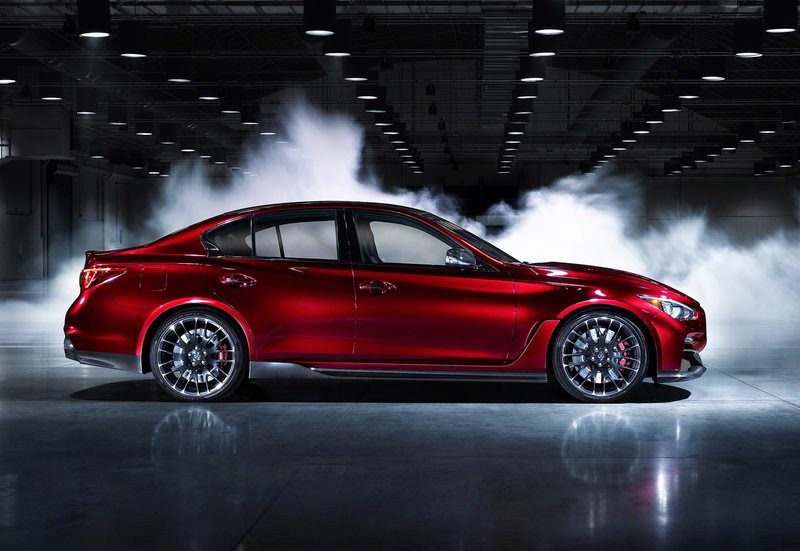
Infiniti Q50 Eau Rouge Concept, 2014

Infiniti Q50 Eau Rouge Concept, 2014, Luxury Automobiless
Infiniti Q50 Eau Rouge Concept, 2014, Luxury AutomobilessInfiniti Q50 Eau Rouge Concept, 2014, Luxury Automobiless
 Infiniti Q50 Eau Rouge Concept, 2014, Luxury AutomobilessInfiniti Q50 Eau Rouge Concept, 2014, Luxury Automobiless
 Infiniti Q50 Eau Rouge Concept, 2014

The Infiniti Q50 Eau Rouge, revealed at the 2014 NAIAS Detroit Motor Show, is a concept car that expresses Infiniti's design vision of a high-performance Q50 premium sports sedan.
The Infiniti Q50 Eau Rouge embodies the arresting design features of the Q50 premium sports sedan - infused with the enticing spirit of Formula One.

Featuring bespoke aerodynamic carbon fiber bodywork, Q50 Eau Rouge is lower and wider, possessing genuine road presence. This striking design is inspired by muscularity, aerodynamics, refinement, and understated power.

Hints at powerful intent
The Infiniti Q50 Eau Rouge was born out of competition at the very pinnacle of motorsport, mirroring components from the successful RB9 race car.

Infiniti Q50 Eau Rouge visibly hunkers down with menace and intent. New front and rear fenders extend the current Q50's already broad-shouldered stance by 20mm, while a larger deck lid spoiler creates air-pressure downforce. All of this dynamic width is wrapped in a tailored coat of customized red paint.

Framing the paintwork across the Q50 Eau Rouge's athletic physique is dark-chrome detailing to replace the chrome bright work of the production Q50, darkening the concept's demeanor dramatically.

Q50's signature double-arch front grille too takes the dark-chrome's matte finish, as do the glasshouse surrounds, door handles and deck lid accents. The curving hood is double air-vented as a further suggestion of the capability and purpose of the Q50 Eau Rouge.

Premium interior. Sporting inspiration
Further underlining the sporty character of the design study, the interior was designed to offer command and comfort.

Further precision control is afforded by a high-grip sports steering wheel and Formula One-style paddle-shifters.
Red-infused carbon fiber detailing to the doors and center console complement the exterior style, and dark-chrome again replaces silver-chrome in the red cockpit.

The breadth and depth of capability is self-evident; the Infiniti Q50 Eau Rouge is a design concept that clearly indicates what Infiniti could achieve if it was to build a performance version of the Q50 sports sedan.


Read More

Hyundai Elantra GT, 2014

Hyundai Elantra GT, 2014, Luxury Automobiles
 Hyundai Elantra GT, 2014, Luxury AutomobilesHyundai Elantra GT, 2014, Luxury Automobiles
 Hyundai Elantra GT, 2014, Luxury AutomobilesHyundai Elantra GT, 2014, Luxury Automobiles
 Hyundai Elantra GT, 2014

Hyundai upped both the horsepower and torque on the refreshed Hyundai Elantra GT to make it even more fun to drive. The GT now includes a standard 2.0-liter Nu Gasoline Direct Injection (GDI) engine, which adds 25 more horsepower (+17 percent) and 23 lb.-ft. of torque (+18 percent) from the prior model year. This powertrain in the Elantra GT produces 173 horsepower available at 6,500 rpm and 154 lb.-ft. of torque on tap at 4,700 rpm. With these gains along with a low curb weight, Elantra GT can now boast the best power-to-weight ratio and specific output in the segment. Furthermore, Elantra GT now produces more horsepower than the Subaru Impreza, Ford Focus, Mazda3 five-door and Volkswagen Golf five-door. To sharpen the look of the 2014 Hyundai Elantra GT, Hyundai engineers added LED taillights. To improve visibility a new integrated driver's blind spot mirror was also added. The 2014 Elantra GT goes on sale in December 2013.

TORQUE-RICH 2.0-LITER NU GASOLINE DIRECT INJECTION ENGINE
The 2014 Elantra GT enjoys the more powerful 2.0-liter Nu engine. Fuel is delivered to the 2.0-liter Nu by a high-pressure Gasoline Direct Injection, which contributes to improved engine response. Power is rated at 173 horsepower at 6,500 rpm and 154 lb.-ft. of torque at a 4,700 rpm, which is a significant improvement compared to the 2013 Elantra GT's 1.8-liter engine that developed 148 horsepower and 131 lb.-ft. of torque. The 2.0-liter Nu has been tuned to provide more torque at 1,500 rpm than the outgoing 1.8-liter Nu. The engine also delivers more torque - from 4,000 rpm to 5,500 rpm - for impressive linear power delivery all the way up to redline.

The powerplant delivers an impressive 24 mpg city/33 highway EPA estimated fuel economy rating with the available six-speed automatic transmission with SHIFTRONIC. (When equipped with the six-speed manual, the Elantra GT achieves 24 mpg city/34 mpg highway EPA estimated fuel economy rating).

The performance gains were achieved by stroking the engine from 87.2 mm to 97 mm to increase the displacement of the engine from 1.8 liters to 2.0 liters and equipping it with a GDI fuel delivery system instead of a MPI fuel delivery system. This high-tech, all-aluminum engine also has Dual Continuously Variable Valve Timing (DCVVT) and a Variable Induction System (VIS) for better engine breathing. A lightweight intake manifold also reduces weight by 30 percent over a cast unit. The aluminum "bed plate" located below the cylinder block reduces engine NVH levels and improves block rigidity by 30 percent.

THE BENEFITS OF GASOLINE DIRECT INJECTION
This shorter, more direct path of fuel delivery allows for greater control of the fuel mixture at the optimum moment, thus improving efficiency. The fuel is injected by a camshaft-driven, high pressure pump that operates at pressures up to 2,175 psi. Direct injection also utilizes a higher than normal 11.5:1 compression ratio for increased power. The pistons are "dished" to increase combustion efficiency in the cylinder.

'FLUIDIC SCULPTURE' DESIGN
The 'Fluidic' essence provides the Hyundai Elantra GT with a slippery .30 coefficient of drag. Everything about Elantra GT is aerodynamic from the aggressive profile and low overall height, to the sleek side mirrors. Tire gaps are minimized while rocker panels are streamlined. Lower wind resistance translates into a smoother ride.

Up front, Hyundai's signature hexagonal grille with chrome accents flows into the hood. The bodyside graphic features a chrome beltline molding to keep up with the sleek character lines. Sharp projection headlamps, fog lights and available 17-inch alloy wheels with chrome spears complete the modern design. It's all finished off in the rear with the new available LED taillights.

THE BENEFITS OF A LOW CURB WEIGHT IN THE COMPACT SEGMENT
Elantra GT's widespread use of high-strength steel allows the suspension to work optimally. At 2,908 pounds, the automatic transmission Hyundai Elantra GT is lighter than most of its competitors, while offering more interior room than Focus, Mazda3 and Golf. Elantra GT is 40 pounds lighter than Focus and 194 pounds lighter than Golf.

SIX-SPEED TRANSMISSIONS
The Elantra GT can be equipped with a six-speed manual (M6CF3-1) or automatic (A6GF1) transaxle with SHIFTRONIC manual control. Elantra GT's six-speed manual transmission provides short, crisp shifts and further optimizes engine performance. These crisp shifts are courtesy of triple-cone synchronizers for first and second gears, double-cone for third gear and single-cone for fourth, fifth and sixth gears.

INTERIOR SPACE AND PRACTICALITY
Maximizing interior volume and delighting customers with various seating layouts are hallmarks of Hyundai engineering and translate into more cabin room, cargo space and versatility. The Hyundai Elantra GT features seating layouts that can comfortably seat five people or accommodate four passengers, plus long items like golf clubs or snowboards. Fold down two seats to seat three people and hold larger packages or fold down all of the back seats to get CUV-sized cargo space. These options allow customers to discover that Elantra GT has more interior volume than Mazda3, Ford Focus and VW Golf and even more cargo capacity than the Nissan Juke crossover, thanks to fold-flat rear seats and rear seat cushions that can flip upward.

The Elantra GT includes a number of convenient, standard stowage and storage features, including a sunglasses holder, two front and two rear cup holders, door bottle holders, cooled glove compartment, central console storage, sliding armrest, front storage tray and front seatback pockets. The cargo area also has a 12-volt outlet for consumers who desire to plug in their portable electronic devices.


Read More