Showing posts with label 2013. Show all posts

Monday, July 14, 2014

Cadillac Elmiraj Concept, 2013

Cadillac Elmiraj Concept, 2013, Luxury AutomobilessCadillac Elmiraj Concept, 2013, Luxury Automobiless
 Cadillac Elmiraj Concept, 2013, Luxury AutomobilessCadillac Elmiraj Concept, 2013, Luxury Automobiless
 Cadillac Elmiraj Concept, 2013, Luxury AutomobilessCadillac Elmiraj Concept, 2013, Luxury Automobiless
 Cadillac Elmiraj Concept, 2013

The Cadillac revealed the Elmiraj Concept, a grand coupe expressing the pure enjoyment of driving and exploring new dimensions for Cadillac's ongoing expansion. The Cadillac Elmiraj Concept showcases a new vision for luxury driving and the top of the brand's expanding range.

At 205 inches (5207mm) in overall length, Elmiraj is four-seat coupe with presence and poise. Taking up from where the memorable Ciel Concept left off, Elmiraj is a statement of pure luxury and performance with a purposeful character and proportion.

The concept advances Cadillac's philosophy of dramatic design and performance, and its commitment to lightweight, agile cars. Elmiraj is constructed with chassis and structural elements of an ongoing Cadillac vehicle development project slated for future production. This new vehicle architecture expands the brand's commitment to lightweight RWD performance, exemplified in the ATS sport sedan and the all-new and elevated 2014 CTS launching in the U.S in the Fall of 2013.

The Cadillac Elmiraj is powered by a 4.5-liter twin turbocharged V8 delivering an estimated 500 hp. The engine takes the baseline technology from the new Cadillac Twin Turbo V6 featured in the upcoming 420-hp 2014 CTS V sport edition, and expands it to the classic performance format of a V8 engine.

Dramatic Exterior Proportion
With a heritage of imaginative designs, Cadillac approaches concept cars as a method for projecting design forward rather than simply exaggerating or "teasing" future production models. Elmiraj was created from this mindset, and therefore suggests new territory for Cadillac Art&Science.

The dramatic proportion communicates power and performance. A long dash-to-axle front profile, a Cadillac signature, gives the coupe a performance-oriented form. The long wheelbase and clean body side characterizes the car's spacious dimensions and elevated status.

The fast cabin sits within a fuselage where taut fender lines spline through the full sectioned body, literally blending art and science. Cadillac's vertical light signature is represented in both the headlamp graphic and tail lamp. A gently applied feature line in the sheet metal extends the full length of the body side, connecting those vertical front and rear elements.

The Cadillac Elmiraj contains design elements emphasizing Cadillac's capabilities for engaging driving performance in its production portfolio. Two vents in the car's long hood are functional, acting as hot air outlets for the twin turbo engine. Elmiraj has 22-x-9-in. aluminum wheels are backed by large ceramic brakes with Cadillac monoblock calipers. The car's rich blue exterior finish wears the brand's Vsport designation, Cadillac's new level slotting directly under the high-performance V-Series.

The face of Cadillac Elmiraj experiments with new visual elements, yet is unmistakably Cadillac. The grille emphasizes the car's substantial road presence. The Cadillac Crest appears in a conceptual form, streamlined and tailored to the car's overall design. This design idea for a revised crest reflects the fact that Cadillac's unmistakable symbol has evolved dozens of times through history to mark new eras or design achievements.

Exquisitely Crafted Interior
The interior of Elmiraj blends elegantly crafted luxury and generous space with driver-focused performance elements. The upper section of the instrument panel is a single piece extending across the full width of the car, while the lower forms a cockpit space tailored for performance.

Backlit titanium trim curves from the cowl to the doors, dividing the rich upper camel leather from the wood trim. Cadillac Studio craftsmen handpicked fallen Brazilian Rosewood, a wood veneer prized for its use for hundreds of years in home furnishings and musical instruments. The wood is hand-cut into three dimensional sections for perfect control of the grain flow.

The car's instrumentation features an analog tachometer and speedometer that are transparent. Directly behind the analog gauges sits a wide screen, high resolution display which projects driver information and the output of a front-mounted camera. A 10-inch touchscreen for navigation and connectivity can be concealed inside the instrument panel when not in use.

The 2+2 layout features high-performance seats, designed to support spirited driving while also delivering luxury accommodation. Elmiraj passengers might actually lobby to sit in the back. The rear bucket seats each contain a valet feature to ease entry and exit. The front bucket seat slides 10 inches forward while the rear bucket seat slides 4 inches forward to meet the passenger, then slides him or her back into position once seated. The rear bucket seats recline for additional comfort.

Many of the most celebrated automotive designs through history have been luxury coupes
Designers at General Motors' advanced design studio in North Hollywood, Calif., under the direction of Frank Saucedo, led the development of the car's interior and exterior. Elmiraj was hand-built by in-house craftsmen in Michigan.

Specifications
Body Style: 4-passenger, 2-door grand coupe
Dimensions
  •         Height: 55 in / 1397 mm
  •         Width: 76 in / 1930 mm
  •         Length: 205 in / 5207 mm
  •         Curb Weight: Approx. 4000 lb / 1814 kg
Powertrain
  •         Engine: 4.5-liter Twin Turbo V8
  •         Power: 500 hp / 373 kW
  •         Torque: 500 lb-ft / 678 Nm


Read More

Wednesday, July 2, 2014

Qoros 3 Estate Concept, 2013

Qoros 3 Estate Concept, 2013, Luxury Automobiless
 Qoros 3 Estate Concept, 2013, Luxury AutomobilessQoros 3 Estate Concept, 2013, Luxury Automobiless
 Qoros 3 Estate Concept, 2013

The Qoros 3 Estate Concept, featuring extended interior space, intelligent and flexible functionality, and elegant design, show how the new brand's compact segment model range might be expanded with an estate variant in the future. Qoros' modular platform provides the ideal basis for fast and efficient expansion of the model family, and the compact estate is becoming increasingly popular among European motorists. Its elegance and bold stature echo the Qoros styling themes introduced by the Qoros 3 Sedan, while the intelligently designed interior provides an incredibly versatile and adaptable space that allows luggage capacity to be adapted to individual needs.

An individual alternative to the classic sedan
Sales of compact segment estate cars are growing thanks to their more flexible capabilities to meet the diverse transport needs of ever more adventurous family lifestyles in Europe. The versatile trunk space provides additional flexibility and volume for luggage or other cargo, or to pursue leisure activities which might involve transporting bulky sports equipment, for example.

The practical advantages are married with the impressive driving dynamics and performance of the Qoros 3 Sedan, and the estate concept pleasingly adopts its timeless, elegant exterior design.

Signature design with distinctive touches
Based on the same platform as the Qoros 3 Sedan, the Qoros 3 Estate Concept is generously-proportioned for a compact segment estate. Appealing touches include the application of the horizontal design theme to highlight the long roof line flowing smoothly to the rear, and the large side windows that give the vehicle an elegant and elongated look.

Like the sedan, the concept has the characteristic Qoros face, featuring the same large headlamps which reach from the distinctive radiator grille far into the flanks. The rear lamp clusters are also identical to those on the product Qoros 3 Sedan, creating a strong family resemblance between the two models. The three bold horizontal LED taillight bars neatly suit the powerful rear, where the large tailgate opening features a convenient low loading sill.

Plenty of space and versatility in the interior
The wide-ranging options provided by the folding rear seatbacks and the ski hatch, as well as the numerous storage compartments and accessory attachments, offer prospective customers a highly versatile and functional vehicle, both for everyday driving and long-distance travel. The Qoros 3 Estate Concept is conceived for young families and other modern customers whose vehicle choice is based on an active, varied lifestyle.
Read More

Tuesday, June 24, 2014

Mazda 6 Wagon, 2013

Mazda 6 Wagon, 2013, Luxury AutomobilessMazda 6 Wagon, 2013, Luxury Automobiless
 Mazda 6 Wagon, 2013, Luxury AutomobilessMazda 6 Wagon, 2013, Luxury Automobiless
 Mazda 6 Wagon, 2013, Luxury AutomobilessMazda 6 Wagon, 2013, Luxury Automobiless
 Mazda 6 Wagon, 2013

The Mazda is reaching for greater heights in a flagship for a new generation and a new level of driving pleasure. With the distinct design, intuitive functionality and exceptional responsiveness that are essential elements of every Mazda. But also blending a dynamic, emotional appeal with the composure mandatory for Mazda's top model. This, of course, posed challenges for designers and engineers as they sought to balance potentially conflicting attributes like form and function, performance and efficiency, comfort and practicality, uniqueness and mass appeal. And in the all-important reputation-making CDsegment, no less.

The SKYACTIV powertrains provide unrivalled linearity and responsiveness. They're a perfect match for the new Mazda 6's equally precise handling, founded on agile yet stable steering and suspension feedback that puts the driver in absolute control. This model marks the latest evolution of Sustainable Zoom-Zoom, Mazda's long-term vision to develop technology for exceptionally safe and environmentally friendly vehicles that also provide the greatest possible driving pleasure. To deliver top-class fuel economy, the all-new Mazda 6 combines the lightweight design common to all SKYACTIV components with uniquely innovative engines and transmissions and Mazda's unique i-ELOOP brake energy regeneration system.

It's remarkably safe thanks to the SKYACTIV-Body, whose highly rigid structure absorbs impact energy and channels it away from the cabin for segment-leading crash protection. Add in the enviable range of active safety technology, and you have an environment where the driver can concentrate on the driving experience while passengers relax and enjoy the ride.

Design-Moving People
As Mazda's next flagship, the all-new Mazda 6 had to be even better than it's predecessor - a model that already achieved top ratings from European customers as well as the media. With striking looks and harmonious forms and textures alongside the uniqueness that precludes the Mazda badge.

At the same time, it needed to attract the broad customer appeal obligatory for CD-segment sedans and wagons in Europe. Mazda designers undertook this complex challenge, working closely with company engineers to make their visions both feasible and highly functional. The result is a new Mazda 6 that will delight customers with its combination of superior build quality and functional, practical beauty that should continue to please the senses well into the future. One look at the all-new Mazda 6 should eradicate any doubts about the skills of Mazda's designers, long known for their unique ability to express motion when shaping vehicles. Their latest evolution is called "KODO - Soul of Motion", a design theme inspired by the movements of animals in the wild - and the look for the new generation of Mazdas. Mazda believes it has captured KODO's purest essence in the all-new Mazda 6, the production model born of the Mazda Takeri concept first showcased at the Tokyo Motor Show in late 2011. Sedan or wagon, it combines a muscular anatomy and vitality with a functional allure that is certain to gain broad market appreciation - and a level of quality that sets it apart.

The Exterior: Shapes that enrich the senses
This is a big achievement in asegment that is so competitive in Europe, representing 6.2 % of the European passenger car market. When designing the Mazda 6, the aim was to come up with a body that clearly sets the vehicle apart from conventional thinking, as unveiled on the Takeri and Shinari concepts, while still furnishing the vehicle with unmistakable dignity and purpose.

The prominent fenders and compactlooking cabin set towards the rear highlight the large-diameter 19-inch aluminium wheels, which only add to the car's composed exterior. The five sets of contoured spokes underline the sense of dynamism and light, effortless motion. And they don't just look good, either. Engineers worked with designers to improve stiffness and thus resistance to deformation. The result is superior handling coupled with reduced noise, vibration and harshness.

The prominent fenders and compact looking cabin set towards the rear highlight the large-diameter 19-inch aluminium wheels, which only add to the car's composed exterior. The five sets of contoured spokes underline the sense of dynamism and light, effortless motion. And they don't just look good, either. Engineers worked with designers to improve stiffness and thus resistance to deformation. The result is superior handling coupled with reduced noise, vibration and harshness. In what is undoubtedly some of their best work yet, Mazda's world-class design team came up with distinctive bodylines whose impressions vary - a sence of speed here, more relaxed there - depending on how the light falls. In doing so, they focused on the interplay between light and shadow, designing a car that one never tires of looking at.

The all-new Mazda 6 is the company's first production model to incorporate LEDs and a new halo ring light into the headlamps. The ring, which surrounds each headlight, accentuates the forward looking stance and mature fearlessness, while the LEDs visually extend the signature wings outwards, adding to the sense of speed.

The Interior: Stunning simplicity
Open the door of the Mazda 6, and this exciting yet dignified consistency continues on the inside. Interior designers paid meticulous attention to detail, enhancing shapes and textures as well as appearances. What they came up with is a harmonious, uncluttered space with an immediately perceptible level of genuine quality and tasteful coordination fitting for a flagship: An interior as stunning as it is sensible.

The various controls received the same finishing. The produces a clean, consistent look throughout the all new Mazda 6 while at the same time making knobs and switches easier to locate visually and therefore operate. Parts like the door handles were given a handpolished aluminium look, with soft materials used for elements that occupants touch the most, such as the steering wheel and armrest. The use of hard plastics was kept to a minimum, with a high-quality finish that underscores the refinement of the Mazda 6 interior while offering practical benefits to driver and passenger alike.

Read More

Monday, June 23, 2014

Maserati Gran Cabrio Sport, 2013

Maserati Gran Cabrio Sport, 2013
 Maserati Gran Cabrio Sport, 2013Maserati Gran Cabrio Sport, 2013
 Maserati Gran Cabrio Sport, 2013Maserati Gran Cabrio Sport, 2013
 Maserati Gran Cabrio Sport, 2013

The new Maserati Gran Cabrio Sport consolidates its presence on the convertible car market with completely revamped exteriors and a more powerful engine. The new front bumper, with redesigned profile to enhance aesthetics and functionality, new headlights, a new, even more powerful engine and an upgraded suspension system make the new Gran Cabrio Sport a point of reference in the convertible car market.

The Exterior
The most highly regarded in the world of sports cars, the Maserati Gran Cabrio Sport's bodywork has undergone a restyling which skilfully harmonises the characteristics of the Gran Turismo Sport.
One of the most evident new features of the Gran Cabrio Sport is the design for the front end with new light clusters. Though they maintain their external form, they now incorporate completely new technological characteristics, including LED Daytime Running Lights technology.

The Interior
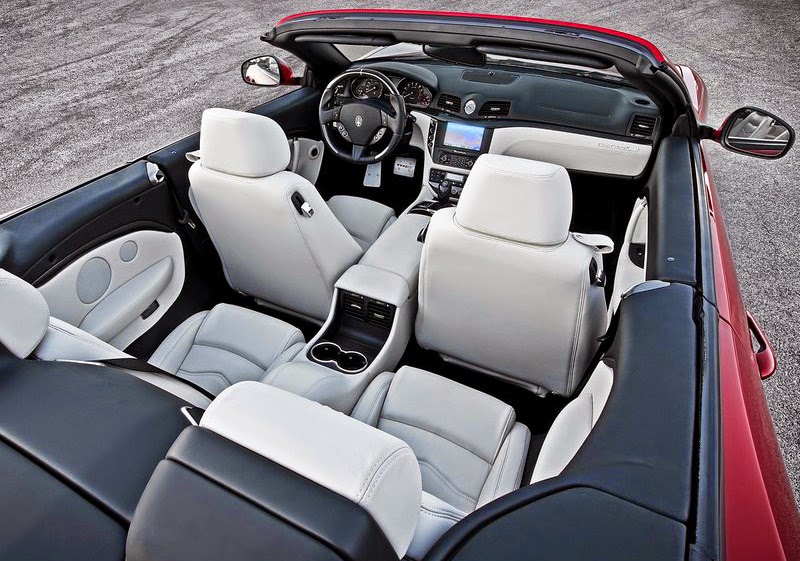
The steering wheel, with new design, is now more ergonomic and, in combination with the extended Trofeo-design paddles and light aluminium pedals, is better suited to sports driving thanks to a flattened rim and accentuated grip profile.
The new grey Eco Chrome materials for the interiors and the Poltrona Frau leather upholstery complete the existing characteristics, such as the steering wheel transmission paddles and the aluminium pedals.

The Engine
The Maserati Gran Cabrio Sport, which comes with a modern V8 engine that has already become a classic, adopts the most recent innovations in the field of engineering to deliver greater power and torque.

Both the hardware and software of the engine have been improved significantly, improving its power by 10 HP and torque by 10 Nm, without adversely affecting consumption or emissions.
At 7,000 rpm, the Maserati Gran Cabrio Sport delivers 338 kW (460 HP) with a considerable torque of 520 Nm at 4,750 rpm.


Read More

Sunday, June 15, 2014

Ferrari F12berlinetta, 2013

Ferrari F12berlinetta, 2013, Luxury Automobiles
 Ferrari F12berlinetta, 2013, Luxury AutomobilesFerrari F12berlinetta, 2013, Luxury Automobiles
 Ferrari F12berlinetta, 2013, Luxury AutomobilesFerrari F12berlinetta, 2013, Luxury Automobiles
 Ferrari F12berlinetta, 2013, Luxury AutomobilesFerrari F12berlinetta, 2013, Luxury Automobiles
 Ferrari F12berlinetta, 2013

The Ferrari F12berlinetta ushers in a new generation of Ferrari 12-cylinders in the form of a car that delivers unprecedented performance from an exceptional new engine, unparalleled handling and innovative design and aerodynamics.

Every time Ferrari has unveiled a new 12-cylinder sports car since 1947, something magical has happened. Perhaps this has to do with the fact that our very first car, the 125 S, was itself a 12-cylinder or maybe it's because purists see the 12-cylinder as the engine size par excellence. Be that as it may, every time a Prancing Horse car of this kind makes its debut, it hails the start of a new era. There have been several 12-cylinder models built here at Maranello that have gone down in the annals of automotive history because of their technological prowess and the results they've delivered. The 1953 375 America, for instance, had an engine derived directly from the F1 single-seater of the day, while the 250 GTO in the 1960s was the perfect melding of styling and performance. That list must also include, of course, the 1969 365 GTB4, better known simply as the Daytona, which, thanks to its brilliantly balanced architecture delivered absolutely unique driving emotions. All of these engines and cars are now eagerly sought after by collectors the world over and each one represented major generational leap forward when it debuted. The story continues today with the Ferrari F12berlinetta which is not merely our latest mid-front 12-cylinder model but the first in a whole new generation of this kind of car. In fact, it is the most high performance Ferrari ever built yet it still effortlessly marries extreme performance with benchmark efficiency, delivering fuel consumption and emissions levels that are 30% lower than the previous generation. The challenge for our engineers and technicians this time was to create a front-engined car with blistering performance that was still able to offer the same driving pleasure and involvement at lower speeds. A difficult task because it meant improving on the design of the 599 GTB Fiorano, deemed the most beautiful Ferrari ever. However, their commitment and determination has produced a car sporting an exceptional new 740 hp mid-front V12 engine that delivers 690 Nm of torque.

Its engine and driver's seat have both been lowered, the wheelbase is shorter and a new suspension and gearbox layout have helped compact the rear. The result is a more compact car than the 599 GTB Fiorano. One that also has perfect weight distribution with 54% over the rear axle and a lower, pulled-back centre of gravity to boot. Thanks to all these characteristics, the Ferrari F12berlinetta delivers truly exceptional performance figures: 0-200 km/h in 8.5 seconds and a lap time at Fiorano of just 1'23". The Ferrari F12berlinetta's spaceframe chassis and bodyshell are both entirely new too and employ 12 different aluminium alloys - some being used for the first time in the automotive sector - and an array of leading-edge assembly and joining technologies. This helped cut the car's overall weight to just 1,525 kg and maximise its performance efficiency, boosting torsional rigidity by 20%. As with every Ferrari, the F12berlinetta's aerodynamics were developed hand-in-glove with its styling, resulting in a plethora of innovative solutions. Not least of these are the Aero Bridge, which uses the car's bonnet to create downforce for the first time, and Active Brake Cooling, a system of guide vanes on the brake air ducts which open when brake operating temperatures are high enough. The result is that the Ferrari F12berlinetta is the most aerodynamically efficient Ferrari ever (a figure of 1.12 - double that of the 599 GTB Fiorano) with a Cd of 0.299 and downforce of 123 kg at 200 km/h.

The product of the ongoing collaboration between the Ferrari Style Centre and Pininfarina, the Ferrari F12berlinetta's design centres around the car's brilliantly bilance proportions. It has an original innovative style featuring typical Ferrari 12-cylinder styling cues. Clothed in sleek, aggressively sculpted lines, it offers a superb standard of occupant space and comfort despite its compact exterior dimensions too.

The Powertrain
The Ferrari F12berlinetta's 200-bar, direct-injection 6262 cc 65° V12 delivers absolutely unprecedented performance for a naturally aspirated 12-cylinder engine. It has a maximum power output of 740 CV at 8250 rpm, while its specific power output is a record-breaking 118 CV/l. Responsiveness and strong pick-up is guaranteed by maximum torque of 690 Nm, 80 per cent of which is already on tap at 2500 rpm, with a constant surge of power all the way up to the 8700 rpm rev limit. Just as is the case with F1 engines, the V12 has very low inertia and thus revs rise very rapidly.

Driving involvement is intensified by the rich, full exhaust soundtrack typical of Ferrari'snaturally-aspirated V12s. The Ferrari F12berlinetta's performance levels give a good idea of the engine's incredible efficiency, where both fuel consumption and emissions are now 30 per cent lower thanks to the Stop&Start system, a "smart" alternator, and Multispark ignition system. These, along with numerous other technical solutions, have reduced internal friction making the F12berlinetta best-in-class for its power-emissions ratio.

The car's compression ratio has also been increased to 13.5:1 and a new 3.0 ECU has been adopted that uses ionisation currents to control sparking and detect misfires. The Multispark ignition generates three sparks of different durations and intensities in quick succession. At low engine speeds, this optimises combustion and, consequently, lowers fuel consumption. The engine is also equipped with Stop&Start and a "smart" alternator which recharges the battery only when there is no demand for power. Meticulous attention was also paid to reducing internal friction, exhaust backpressure and intake depressurisation. The cylinder block has four oil scavenge pumps with rotors using smaller diameter blades which optimise extraction efficiency. Lubrication is guaranteed by an engine oil pump with variable geometry. The design of the pistons includes an anodising treatment to the first piston groove, with PVD (Physical Vapour Deposition) coating on the first piston ring and Graphal-coated piston skirts. All of this reduces friction between the piston and the cylinder liner. The camshafts are super-finished using a lapping process that reduces surface roughness to under 0.05 Ra, thus minimising the coefficient of friction between the cam lobes and the tappets. The tappets themselves have been given a DLC (Diamond Like Carbon) coating that reduces their coefficient of friction, increasing performance and reducing fuel consumption.

The cylinder head features different conduit designs, new intake manifolds and new plenums fitted with resonators. The resonators create overpressure inside the intake tract the moment the intake valve opens and immediately before it closes, guaranteeing improved cylinder filling and generating a powerful supercharging effect which increases engine performance. The whole exhaust sequence has also been optimised - the catalysers have been miniaturised and hydroformed manifolds have been adopted, reducing their form and size without impinging on their capacity, resulting in improved permeability and reduced backpressure. The system's geometry and materials have been developed to harmonise the intake and exhaust soundtracks to underscore the car's extremely sporty character. All of the pipes connecting the 6-in-1 exhaust manifold to the single catalyser per bank are of equal length and this optimises the sound giving predominance to the first-order combustion harmonics. The characteristic engine sound can clearly be heard in the cockpit in all driving conditions.

The seven-speed F1 dual-clutch transmission boosts both performance and ride comfort at once. The technology involved is based on the independent management of odd and even gears which are pre-selected using two different in-put shafts. Gear shifting time - calculated as the overlap between the opening and closing phases of the two clutches - is thus zero and there is no interruption of torque delivery to the wheels. Shortened ratios have been developed for the Ferrari F12berlinetta and 7th gear is a direct ratio, not an overdrive, to ensure that the car's huge performance potential can be exploited in every gear. The E-Diff3 electronic differential has also been integrated into the gearbox, helping to cut the car's overall weight.

The Architecture
The Ferrari F12berlinetta delivers truly extraordinary performance and driving involvement thanks to its highly evolved transaxle architecture which was developed with extremely ambitious objectives in mind. These were to reduce overall weight, lower and move the centre of gravity rearwards in the chassis, and reduce the car's frontal area whilst contemporaneously increasing passenger and luggage space compared to the previous V12 coupé to ensure maximum comfort over lengthier journeys. To achieve these objectives, the engineers lowered the engine, dashboard and seats. Furthermore the rear of the car is now more compact, thanks to the repositioning and reduction in size of the fuel tank (permitted in part by a more efficient engine which delivers the same range as before) and to the new transaxle layout allowed by the rear multi-link suspension and F1 dual-clutch transmission with integrated electronic differential. Rather than a traditional separate boot, the F12berlinetta features a generous tail-gate incorporating the rear screen which contributes both to the compactness of the design, and the generous luggage space and its accessibility, while ensuring maximum structural rigidity. The solution also ensures that more of the car's mass sits inside the shorter wheelbase to the benefit of handling dynamics. The end result is a car that's lighter by 70 kg with a centre of gravity that's 25 mm lower. It's also shorter (-47mm), lower (-63 mm) and narrower (-20 mm) compared to the previous V12 coupé. The rear overhang has been greatly reduced (-82 mm) while the front one has been estende (+65 mm) to accommodate the cooling systems required for the powerful V12 engine. Weight distribution is ideal - 54% at the rear - and is unmatched by competitors within the segment.

Chassis and Bodyshell
The Ferrari F12berlinetta's spaceframe chassis and bodyshell are completely new and use different types of materials and technologies, many of which originated in the aeronautical industry. No fewer than 12 different types of alloy have been used, including two new structural alloys. This has helped keep the car's weight down (50 kg has been saved on the body-in-white alone which equates to a saving of 90 kg if the previous chassis were re-engineered to meet crash legislation) and maximise the efficiency of its performance (torsional rigidity has been increased by 20 per cent). Crash resistance (lateral pole impact and roof roll-over) is already in line with future legislative requirements and particular attention was taken during the design phase to improving production quality, and minimising repair times and thus costs for the client.

The Aerodynamics
The Ferrari F12berlinetta's aerodynamics were developed hand-in-hand with its styling, using CFD (computational fluid dynamic) simulations along with more than 250 hours of testing in the Wind Tunnel. Aside from external air flows, research focused on internal ones with particolar attention given to thermal factors (including the radiators, heat exchangers and brakes). Apart from boosting the car's fluid dynamic efficiency, this research also led to a reduction in volumes through the optimised packaging of the car's mechanical components. The result is that it is the most overall aerodynamically efficient Ferrari ever, a fact attested to by a figure of 1.12 (double that of the 599 GTB Fiorano). Downforce has been boosted by 76 per cent (123 kg at 200 km/h) while drag has been significantly reduced (the Cd is just 0.299).

The Ferrari F12berlinetta's aerodynamic efficiency brass is mostly generated by three elements: the Aero Bridge, the Blown Spoiler, the aerodynamic underbody. The Aero Bridge is an innovative solution that uses the bonnet to create downforce for the first time. It does so by availing of an aerodynamic channel on each side. These pass below a bridge in the area between the front wheelarch and the bottom of the A-pillar and deflect the airflow into scoops in the flanks where it interacts with the wake from the wheel wells to decrease drag. The Blown Spoiler uses the air flows near the rear of the car to modify, via special intakes, the pressure field in the wheel well, boosting overall efficiency. Lastly, the car's flat underbody has been greatly evolved, not least thanks to the fact that the front splitter which is now separate to the bumper. 


Read More

Tuesday, June 10, 2014

Cadillac ATS, 2013

Cadillac ATS, 2013, Luxury Automobiles
 Cadillac ATS, 2013, Luxury AutomobilesCadillac ATS, 2013, Luxury Automobiles
 Cadillac ATS, 2013, Luxury AutomobilesCadillac ATS, 2013, Luxury Automobiles
 Cadillac ATS, 2013

The Cadillac ATS is a new expression of Cadillac's Art & Science execution philosophy, built on a foundation of driving dynamics and mass efficiency. It is the most agile and lightweight Cadillac, with one of the lowest curb weights in the segment - less than 3,400 pounds (1,542 kg).
The rear-drive ATS brings Cadillac's blend of technologically driven performance, elegance and design to a new audience of spirited drivers. Its sophisticated driving experience is enhanced with Cadillac CUE, a comprehensive, in-vehicle user experience that merges intuitive design with industry-first controls and commands for information and media data.

Germany's famed Nürburgring served as one of the key testing grounds, along with additional roads, racetracks and laboratories around the globe, ATS engineers balanced performance with Cadillac's trademark refinement. Contributing components and features:
  • Nearly 50/50 weight balance
  • Cadillac's first five-link independent rear suspension using lightweight, high-strength steel and efficient straight link designs
  • A multi-link double-pivot Mac Pherson-strut front suspension with direct-acting stabilizer bar
  • Driver-adjustable FE3 sport suspension with Magnetic Ride Control real-time damping
  • Underbody aerodynamic shields
  • Premium (belt driven) electric variable-effort steering gear from ZF Steering Systems
  • Four-channel ABS with available Brembo performance brakes
  • Available all-wheel drive

A broad lineup of engines - including two four-cylinders and a V-6 for North America - delivers strong power to the Cadillac ATS and capitalizes on the car's lightweight structure to complement its performance with efficiency. The optional engines include an all-new 2.0L turbocharged four-cylinder rated at 270 horsepower (201 kW) and Cadillac's award-winning 3.6L V-6, estimated at 318 horsepower (237 kW).

At 135hp/L, the new 2.0T is one of the most power-dense engines in the industry, topping engines from European competitors. Cadillac ATS will offer both manual and automatic transmission options, along with rear-wheel and all-wheel-drive configurations.

The Cadillac ATS will deliver peak highway fuel economy of more than 30 mpg.
A spirit of lightness and balance
Making the Cadillac ATS one of the segment's lightest cars was a fundamental criterion for and the guiding principle during its development, but it was done in a nuanced manner that ensures a refined driving experience.

Optimizing the Cadillac ATS's mass was the result of a four-pronged philosophy that included strict adherence to original architectural goals, measured load management throughout the vehicle, benchmarking components to see if lighter solutions were available and an overall culture that "weighed" the mass of every component in the car against all aspects of its development.

An aluminum hood, magnesium engine mount brackets and even lightweight, natural-fiber door trim panels contribute to the Cadillac ATS's low overall mass - and reflect the systematic approach of evaluating every gram that went into the car. But some weight was deemed not only beneficial, but essential to the Cadillac ATS's driving experience. An example is the cast iron differential: Engineers found they could improve fuel economy with a cast iron differential rather than a lighter aluminum version.

And while the rear suspension is mostly steel, the focus on load management and straight links enabled significant weight savings without using alternate materials. This helps offset the weight of the engine and transmission at the front of the vehicle, helping the Cadillac ATS deliver its near-perfect 50/50 weight balance, while also contributing to lower noise and vibration. A similar approach was taken on the wheels, where extra structural aluminum was strategically added to further reduce vibration.
Read More

Buick Enclave, 2013

Buick Enclave, 2013, Luxury AutomobilesBuick Enclave, 2013, Luxury Automobiles
 Buick Enclave, 2013, Luxury AutomobilesBuick Enclave, 2013, Luxury Automobiles
 Buick Enclave, 2013, Luxury Automobiles
Buick Enclave, 2013

The Buick introduced the new 2013 Enclave, an evolution of the industry's best-selling three-row luxury crossover. It offers new styling, new safety technologies, in-vehicle connectivity and a more refined driving experience.

The LED daytime running lamps and LED tail lamps complement a more sculpted exterior design. The interior is more contemporary, with ambient lighting and Intelli Link in-vehicle communications with touch-screen control and navigation. The industry's first front center air bag system and new dual-flow front struts highlight the safety and performance enhancements.

The Enclave is offered in front-wheel-drive and all-wheel-drive models, and powered by a direct-injected 3.6L V-6 and an updated six-speed automatic transmission that contribute to the more refined driving experience. Buick's Quiet Tuning engineering process reduces, blocks and absorbs unwanted noise from the Enclave's cabin, making it quieter than a Lexus RX350.

Buick Enclave's sculpted styling redefined Buick's design language upon its introduction more than five years ago. The 2013 model adds new signature cues:
  • New front fascia with LED daytime running lamps
  • New headlamp design, with standard Xenon high-intensity discharge lamps (HID) and LED accent lighting. Articulating headlamps are available
  • New hood and black-chrome waterfall grille
  • New rear fascia design with integrated exhaust outlets
  • New LED tail lamps
  • New 19-inch and 20-inch aluminum wheel designs
  • Monochromatic exterior appearance with chrome accents.

The Buick Enclave's new appearance is instantly recognizable as a modern Buick and the LED lighting elements enhance its technologically advanced presence. The blue translucent rings around the Xenon HID headlamps are Buick design cues found on other models, adding distinction across the brand's lineup.

At the rear, the exhaust outlets are framed with a chrome finish within the rear fascia, for an integrated appearance that exemplifies Buick's attention to detail. New LED taillamps provide a safety benefit by illuminating more quickly than conventional bulbs when the brakes are applied.

Harmonious interior environment
The 2013 Enclave's interior is defined by luxurious amenities and high-quality materials, with changes that create a more contemporary ambience and support the integration of Buick IntelliLink.

Highlights:
  •     New ice blue LED ambient lighting around the dash highlights Enclave's flowing lines, emphasizing the cabin's spaciousness
  •     Eight-way power front driver and passenger seats with four-way adjustable head restraints emphasize seat comfort
  •     Details including soft touch materials and live stitching throughout the cabin, as well as true chrome accents
  •     Four interior color combinations are available with complementing wood tones, including a new Cocoa leather combination
  •     A new "center stack" with standard IntelliLink LCD display, tri-zone climate system, capacitive touch controls and available navigation system.
The new center stack was developed for easy, intuitive interaction with the new IntelliLink system, along with redundant controls on the genuine Mahogany-accented steering wheel. The tri-zone climate system's new controls are designed to be more intuitive, too, with easier, at-a-glance operation, bold digital temperature readouts and larger controls that are easier to operate with gloves.

Buick Enclave offers three rows of seating, available in seven- or eight-passenger configurations. The second-row seats feature the SmartSlide system, which allows easier entry to the third row, with the pull of a single handle. There is 23.3 cubic feet (660 liters) of cargo space behind the third row and a maximum of 115.2 cubic feet (3,263 liters) of cargo space available when the second and third rows are folded. That's more than the Mercedes-Benz R Class, Infiniti JX, Acura MDX, Lincoln MKT, Audi Q7 and the Volvo XC90.

Read More

Saturday, May 31, 2014

Qoros 3 Cross Hybrid Concept, 2013

Qoros 3 Cross Hybrid Concept, 2013, Luxury Automobiles
 Qoros 3 Cross Hybrid Concept, 2013, Luxury Automobiles Qoros 3 Cross Hybrid Concept, 2013, Luxury Automobiles
 Qoros 3 Cross Hybrid Concept, 2013

The concept illustrates how the design themes introduced in the Qoros 3 Sedan may be applied to its future model range. It also offers a glimpse ahead to the brand's future technological developments with a pioneering hybrid drive that not only enhances efficiency but that also provides an exceptional all-wheel driving experience.

The Qoros modular vehicle architecture is a key factor in ensuring that new models can be introduced quickly and efficiently, and the Qoros 3 Cross Hybrid Concept is based on the same vehicle platform as the Qoros 3 Sedan.

Hallmark design features reinterpreted
The Qoros 3 Cross Hybrid Concept showcases a mild evolution of the styling introduced on the production sedan. Elegant lines and balanced proportions reflect sporty aspirations. Short body overhangs and the coupé-like roof line flowing into the hatchback tailgate give the five-door model a touch of dynamic flair. Horizontally oriented lines highlight the width of the boldly shaped rear, which featuresa large tailgate.

The front view of the concept is almost identical to the Qoros 3 Sedan, but the core elements of the Qoros 'face' are supplemented with bespoke accents. The lower air inlet at the bottom of the trapezoidal grille stretches further back, highlighting the concept's powerful front stature. Also distinctive are the rounded contours of the fog lamps, which are placed wide apart.

The headlamp clusters, featuring LED bars at their top edge as daytime running lights, are the same as those on the Qoros 3 Sedan, stretching far into the flanks and into a striking contour edge which runs through the door handles and rises continuously to the rear. The rear light clusters - unique to this concept, feature horizontal LED light bars in a neat compact arrangement.

Its raised ground clearance and specific design features that emphasise its robust, versatile characteristics hint at the Qoros 3 Cross Hybrid Concept's potential for excursions beyond the asphalt. It features underbody protection at the front and rear to protect against impacts, as well as uprated suspension and damper systems that ensure occupants remain comfortable even on rough terrain.

A combination of hybrid drive and all-wheel system for increased driving pleasure and efficiency
The development of advanced engineering innovations is a core strategic activity for the brand and the Qoros 3 Cross Hybrid Concept features an advanced hybrid drive system developed in partnership with leading electric drive systems specialist American Axle.

A three-cylinder 1.2-litre turbocharged petrol engine with 97 kW (130 bhp) is installed transversely at the front to drive the front wheels.

A 50 kW electric motor is housed between the luggage compartment floor and the rear axle, not only convenient for power transfer but also safely isolated from rear collision impacts. The motor is powered by a LG Chem lithium-ion battery with a maximum capacity of 1.9 kilowatt-hours.

A second electric motor - the Integrated Starter Generator (ISG)-is mounted between the petrol engine and the transmission. Its role, as well as to start the petrol engine more discreetly - with less noise and less vibration - than a traditional starter motor, is to charge the rear electric motor's dedicated battery so that the Qoros 3 Cross Hybrid Concept can operate continuously in all-wheel drive mode. And, during the most demanding driving, the ISG delivers additional power to the front axle, allowing the concept to deliver surprisingly swift performance: zero to 100 km/h is achieved in less than 7.0 seconds (provisional target, not yet verified).

Intelligent control software ensures seamless transition between petrol-engine front-wheel drive, electric motor rear-wheel drive, and all-wheel drive, depending on the most efficient mode to respond to the driver's inputs and the prevailing road conditions.

The Qoros 3 Cross Hybrid Concept can be driven in pure-electric mode at a speed of up to 120 km/h, and for a maximum range of approximately four kilometres (provisional target, not yet verified).


Read More

Wednesday, May 28, 2014

Morgan Plus 8, 2013

Morgan Plus 8, 2013, Luxury Automobiles
 Morgan Plus 8, 2013, Luxury AutomobilesMorgan Plus 8, 2013, Luxury Automobiles
 Morgan Plus 8, 2013, Luxury AutomobilesMorgan Plus 8, 2013, Luxury Automobiles
 Morgan Plus 8, 2013

The new Morgan Plus 8 makes use of technology from the aircraft industry to achieve an unladen weight of only 1100kgs. This makes the Morgan Plus 8 the lightest V8 passenger car in the world approved to European safety standards. The car also has one of the stiffest chassis of all the convertible roadsters available today.

The car is the ideal companion on country and urban roads. It responds immediately to a driver's input yet you can also have fun with a clear conscience knowing that the car's impact on nature is kept at a minimum. Wheel speed sensors inform the Electronic Control Unit to get the best possible performance from the engine and to provide a crisp throttle response. The Morgan Plus 8 has been described as 'a true drivers car' yet it is also surprisingly economical to run.

The car is the most comfortable classic Morgan that the company has ever built. The convertible mohair roof is easy to erect with a double thickness liner for insulation. There is plenty of space for the tallest of drivers. Air conditioning is standard equipment in the luxurious leather lined cockpit which includes a lockable stowage compartment. A radio/CD player is standard equipment with a high quality speaker system.

The Morgan Plus 8 is also the only Classic Morgan available with a six speed automatic transmission. This can be operated in two modes, 'Sport' and 'Auto'. In 'Sport' mode the engine holds its gear to maximum revs of 6500rpm and 'blips' the throttle before making a down shift. The steering and the ABS brakes are power assisted.


Read More

Monday, May 26, 2014

Mazda 6 Sedan, 2013

Mazda 6 Sedan, 2013, Luxury Automobiles
 Mazda 6 Sedan, 2013, Luxury Automobiles Mazda 6 Sedan, 2013, Luxury Automobiles
 Mazda 6 Sedan, 2013, Luxury Automobiles Mazda 6 Sedan, 2013, Luxury Automobiles
 Mazda 6 Sedan, 2013, Luxury Automobiles Mazda 6 Sedan, 2013, Luxury Automobiles
 Mazda 6 Sedan, 2013

Mazda premieres the completely redesigned Mazda 6 at 2012 Moscow Motor Show. Following on from the Mazda CX-5, the all-new Mazda 6 is the second of a new generation of Mazda vehicles which adopt the full range of SKYACTIV technology and the "KODO - Soul of Motion" design language. Mazda has consistently strived to provide stylish, insightful and spirited cars and the new generation vehicles also offer outstanding environmental performance.

Mazda's environmental technology development is directed by its Building Block Strategy which first calls for thorough improvements in the base automotive technologies. The next step builds on these improvements with the sequential introduction of electric devices designed to improve fuel economy. The first such device was the i-stop idling stop system introduced in 2009 with the Mazda 3. The second device, which makes its debut with the new Mazda 6 is i-ELOOP, Mazda's unique brake energy regeneration system which begins charging a capacitor the moment the driver takes his foot off the accelerator. Electricity stored in the capacitor can then be used to power electric components throughout the car. In freeing the engine from much of the duty of providing electricity to these components, more fuel energy goes directly to powering the car resulting in further improvements in fuel economy. In addition, a variety of advanced active safety technologies have been adopted. The new Mazda 6 delivers not only precise response and a high-quality, exhilarating driving experience but also outstanding environmental and safety performance.

The Design
The new Mazda 6 is the mass production model born of the Mazda Takeri concept car first showcased at 2011 Tokyo Motor Show. "The new Mazda 6 has a robust framework and a low, wide stance that expresses strength and stability, creating the impression of amazing vitality without detracting from the universal aesthetic appeal and beautiful form it displays as a CD car," says Chief Designer Akira Tamatani. "We have created a design in which the wild and dynamic expressions of motion artistically realize a powerful presence. Simply looking at the car heightens one's expectations about the driving experience even before actually riding in it."

At a single glance, the exterior design conveys animalistic tenacity, dignity and a sporty flare through its smooth and powerful physique. The coordinated interior, in keynote black, is both chic and contemporary without compromising on a timeless feeling of luxury and quality.

The Exterior
In the front view, the 'signature wing' is incorporated, a unifying element of the new Mazda family face design, into the deeply sculpted face. The hood creases extend from the tips of the signature wing and flow into the body character lines. Together with the solid design of the nose, they complement the overall dynamic form of the body that expresses a strong desire for motion.

Three character lines dominate the side view - an elegant line that extends forward from the rear tire, a rear fender line suggesting driving force from the vehicle's hind quarter, and a front fender line denoting strong shoulders supporting nimble forefeet. The combination of these lines capture the form of a predator crouched and ready to leap forward in an explosion of movement.

The rear view displays stability through the well balanced proportions of the wedged body, prominent rear fender and compact cabin.
For the head lights, signature LED luminescence and halo ring light guides are adopted for the first time in a Mazda mass production vehicle.
The first use of "Soul Red", a new color born of a unique technological process developed by Mazda, that balances depth and shading which accentuate the car's dynamic form, and vividness which expresses sportiness.

The Interior
The driver-oriented cockpit offers generous space. Three meters laid out symmetrically in the meter hood heighten the expectation for exciting driving.

The passenger side space provides a sense of both openness and safety with the decorative horizontal line extending through the center panel to the air-conditioning louvers as well as with the encircling form of the dash.
Soft materials are used for areas frequently touched such as the door trim and the upper part of the instrument panel.


Read More