Showing posts with label Maserati. Show all posts

Monday, June 23, 2014

Maserati Gran Cabrio Sport, 2013

Maserati Gran Cabrio Sport, 2013
 Maserati Gran Cabrio Sport, 2013Maserati Gran Cabrio Sport, 2013
 Maserati Gran Cabrio Sport, 2013Maserati Gran Cabrio Sport, 2013
 Maserati Gran Cabrio Sport, 2013

The new Maserati Gran Cabrio Sport consolidates its presence on the convertible car market with completely revamped exteriors and a more powerful engine. The new front bumper, with redesigned profile to enhance aesthetics and functionality, new headlights, a new, even more powerful engine and an upgraded suspension system make the new Gran Cabrio Sport a point of reference in the convertible car market.

The Exterior
The most highly regarded in the world of sports cars, the Maserati Gran Cabrio Sport's bodywork has undergone a restyling which skilfully harmonises the characteristics of the Gran Turismo Sport.
One of the most evident new features of the Gran Cabrio Sport is the design for the front end with new light clusters. Though they maintain their external form, they now incorporate completely new technological characteristics, including LED Daytime Running Lights technology.

The Interior
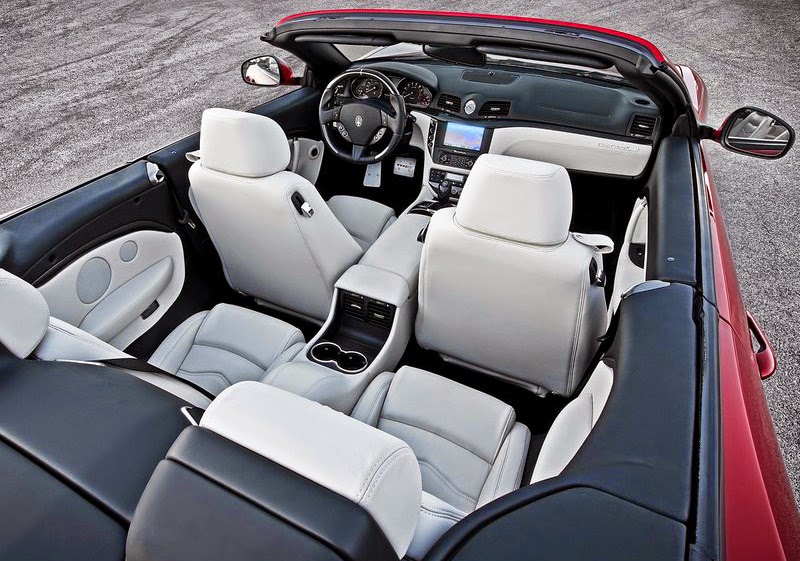
The steering wheel, with new design, is now more ergonomic and, in combination with the extended Trofeo-design paddles and light aluminium pedals, is better suited to sports driving thanks to a flattened rim and accentuated grip profile.
The new grey Eco Chrome materials for the interiors and the Poltrona Frau leather upholstery complete the existing characteristics, such as the steering wheel transmission paddles and the aluminium pedals.

The Engine
The Maserati Gran Cabrio Sport, which comes with a modern V8 engine that has already become a classic, adopts the most recent innovations in the field of engineering to deliver greater power and torque.

Both the hardware and software of the engine have been improved significantly, improving its power by 10 HP and torque by 10 Nm, without adversely affecting consumption or emissions.
At 7,000 rpm, the Maserati Gran Cabrio Sport delivers 338 kW (460 HP) with a considerable torque of 520 Nm at 4,750 rpm.


Read More

Monday, May 5, 2014

Maserati Gran Cabrio MC, 2013

Maserati Gran Cabrio MC, 2013, Luxury Automobiles Maserati Gran Cabrio MC, 2013, Luxury Automobiles
 Maserati Gran Cabrio MC, 2013, Luxury Automobiles Maserati Gran Cabrio MC, 2013, Luxury Automobiles
 Maserati Gran Cabrio MC, 2013, Luxury Automobiles Maserati Gran Cabrio MC, 2013, Luxury Automobiles
 Maserati Gran Cabrio MC, 2013

Exterior
The new, sporty look can be seen in each stylistic element of the Maserati Gran Cabrio MC's bodywork. Inspired directly by the cars of the Maserati Trofeo MC World Series and the GT4 version, the new design perfectly blends sportiness, dynamism, the search for aerodynamic perfection, elegance and style. These stylistic elements already partly characterised the Gran Turismo MC Stradale and the Gran Turismo Sport, and seamlessly unite form and function.

The car, 48 millimetres longer than the Gran Cabrio and GranCabrio Sport, is characterised by a front end which is inspired directly by the MC Stradale, adopting a profile designed to optimise the aerodynamic lift and flow. These differ from those on other versions of the Gran Cabrio due to the increased car length and other aerodynamic elements at the rear end.

The bonnet incorporates two generous air outlets at the centre to optimise cooling of the powerful V8, and two more air outlets to cool down the brake discs have also been added to the two front wings.

Initially introduced on the Gran Turismo Sport the new headlights, which adopt LEDs for the daytime running light (DRL) function, complete the new look of the Maserati Gran Cabrio MC. Though they maintain the external shape seen on the other three versions in the Gran Cabrio range, the new headlights adopt the most modern technology, perfectly enhanced with an extremely sporty look thanks to the matt black colour of the structure.

The bi-xenon unit inside the headlight also incorporates Adaptive Light Control, which follows the movement of the steering by up to 15 degrees.

The rear is characterised by the large spoiler, for greater negative lift at high speeds. Inside the spoiler, built into the luggage compartment, is the third brake light. The standard version comes in the same colour as the body and it is also available, within the various car customisation packages, with a carbon finish.

The bumper has been completely redesigned at the bottom to make the new model even sportier and at the same time ensure optimal aerodynamic efficiency. The circular exhausts have been moved to the centre of the bumper and the specific layout of the air ducts, built into the lower part of the bumper, ensure greater streamlining, stabilising the air flow from the underbody.

Finally, the dynamism of the Maserati Gran Cabrio MC is accentuated by the 20" MC Design rims, available in glossy Titanio or matt Grafite, and made using flow-forming technology. In addition to being lighter, they feature the traditional Trident, skilfully worked into the double-spokes.

The Interior
The interior of the Maserati Gran Cabrio MC has received a thorough overhaul with particular attention paid to ergonomics.

The new seats, completely redesigned from both an aesthetic and functional point of view and enhanced with high-quality materials, now ensure the optimum balance of comfort and performance, elegance and functionality. The new structure of both the front and rear seats now incorporates the headrest and is enhanced by an upper, central trim, with a design inspired by the car's front grille.

Particularly important, especially with convertible cars, is the attention paid to the rear passengers. For this reason, the frame for the front seats, which is also available in a completely carbon-fibre version, has been completely redesigned to ensure 20 mm more legroom for the rear passengers.

Particular attention has been paid to the ergonomic and comfort-related aspects of driving. The seats, with an increased profile to enhance their wrap-around structure and lateral containment, ensure sporty driving while guaranteeing superior comfort, even on very long journeys.

The steering wheel features a new design, with the rim flattened at the top and bottom for greater manoeuvrability, also for sports and high-speed use, without interfering with the driver's legs.

The rear seats have been redesigned according to the same logic: maximum comfort, maximum passenger restraint in sports driving and ample use of quality materials.

To complete the new, super-sporty look of the new Maserati Gran Cabrio MC, it incorporates the Trofeo-design steering wheel paddles as standard, with increased dimensions as seen on the Gran Turismo Sport, and an aluminium pedal unit.

The Engine and performance
As with the most sporty Gran Turismo in the range (the Gran Turismo Sport), the Gran Cabrio MC also adopts the new 4.7-litre V8 engine, which delivers 338 kW (460 HP) together with substantial torque of 520 Nm at 4,750 rpm.

The pistons, positioned at an angle of 90°, are made of reinforced, hardened aluminium, as is the engine block. The crankshaft, with five-point balancing, is made of high-strength steel.

The timing system, with a system of two chains per bank, features dual variable valve timing.
The new power unit, in combination with the MC Auto Shift transmission, is now able to propel the Maserati Gran Cabrio MC, in closed soft top configuration, to a top speed of 289 km/h (179 mph) with acceleration of 0 to 100 km/h in 4.9 seconds.

Automatic transmission (MC Auto Shift)
Like other sports models in the Maserati range, the Maserati Gran Cabrio MC also adopts an automatic six-speed ZF transmission able to transfer all the power of the 460 HP V8 engine to the ground. Calibrated specifically for application on the sportiest version in the Gran Cabrio range, the MC Auto Shift transmission features five operating modes. It can be used in Auto-Normal, Auto-Sport, Manual-Normal, Manual-Sport and Ice modes.

In Manual mode, gear changes are carried out directly by the driver through the steering wheel paddles, as with a truly manual gearbox. In Manual-Normal mode, the driver can change gear until the threshold value is reached, while in Manual-Sport mode the gear is maintained until the driver next changes gear, even if this may result in over-revving and the intervention of the limiter.

On the Gran Cabrio Sport, Sport mode includes super-fast mode, which derives directly from the Gran Turismo Sport and the Quattroporte Sport GT S and permits gear changes that are 50% faster.

The mode includes automatic blipping (short burst of acceleration) when downshifting with the Launch Control system, called MC Start Strategy(which operates only with MSP deactivated).
Using the MC Start Strategy, the driver holds down the brake pedal, presses the accelerator pedal and then releases the brake pedal when the optimum engine speed is reached (2,300-2,500 rpm).

Chassis and suspension
Performance, safety and comfort were the guidelines that Maserati engineers followed when designing the chassis for the new Gran Cabrio MC. In light of the experience gained with the GranTurismo MC Stradale, it is fitted with single-rate dampers, to give maximum emphasis to the car's sporty character, which guarantee greater rigidity in order to ensure optimum road holding in all driving conditions, without detracting from maximum passenger comfort.
Read More

Friday, April 18, 2014

Maserati Alfieri Concept, 2014

Maserati Alfieri Concept, 2014, Autos, Luxury Automobiles, Automotive, Car ConceptMaserati Alfieri Concept, 2014, Autos, Luxury Automobiles, Automotive, Car Concept
 Maserati Alfieri Concept, 2014, Autos, Luxury Automobiles, Automotive, Car Concept
 Maserati Alfieri Concept, 2014, Autos, Luxury Automobiles, Automotive, Car ConceptMaserati Alfieri Concept, 2014, Autos, Luxury Automobiles, Automotive, Car Concept
 Maserati Alfieri Concept, 2014

Maserati unveiled the Alfieri, a 2+2 concept car to celebrate the brand's centenary at the 2014 Geneva Motor Show. The Alfieri is an exciting but realistic and 100% functional prototype that says much about the design DNA of future Maseratis; it could well be a door to the future of the Trident Marque.

The striking new concept bears the name of Alfieri, the most prominent of the Maserati brothers and the engineering genius who founded "Officine Alfieri Maserati" in Bologna a century ago. The Alfieri was created at the Maserati Centro Stile in Turin by a group of talented young designers, under the direction of Marco Tencone overseen by Lorenzo Ramaciotti.

The Design
The Alfieri is being unveiled at just the right time to re-establish Maserati's orientation in terms of design and production. If the new Quattroporte and Ghibli gave the impression that Maserati was becoming oriented towards sporty, premium four door saloons, the Alfieri concept is a reminder that the brand has a remarkable racing heritage and a unique tradition in exotic GT cars.

As with all concept cars, there is a strong desire to turn the Alfieri into reality. It was conceived, designed and created in an approach aimed at 100% realism.

According to Lorenzo Ramaciotti, "The Alfieri is a transition point between 100 glorious years of history and the future that is opening up before us. I can't honestly say that we'll see this car in production in the next two years, but I'm certain we'll see something very similar."

The development process kicked off last summer When the designers were asked to start from a blank sheet to create a concept for Maserati's centenary. Among various proposals, the sketches that would lead to what is now the Alfieri emerged.

One of the most fascinating cars of all time, the Maserati A6 GCS-53 designed by Pininfarina in 1954, proved a valuable source of inspiration for the designers. Far more than a rare racing machine for gentlemen drivers, the A6 GCS-53 was a masterpiece of design. It was also the last car that, at that time, the Carrozzeria Pinin Farina designed on a Maserati model before making a comeback in the first decade of the 21st century with the Quattroporte and the GranTurismo.

The A6 GCS-53 was an iconic piece of automotive technology and simply breath-taking for its proportions and design features: a diminutive cabin positioned almost over the rear wheels, a seemingly endless bonnet and long, sinuous wings stretching nearly to the rear wheels.

The Alfieri is obviously much more than a futuristic interpretation of the A6 GCS-53. Maserati has a diversified design history that encourages designers to look forward rather than back: "We wanted the Alfieri to test future design paths", Ramaciotti explains. "The car is very aggressive yet subtle in style, forceful but understated."

The acronym A6 GCS stood for Alfieri 6 cylinder, Ghisa, Corsa, Sport, epithets that characterise its long bonnet and rear-set 2 seat cabin.

While the inverted A pillars of the A6 GCS-53 were not adopted in the new Alfieri, their optical effect has been recreated by a sculptured line that starts from the bonnet and fades to the upper part of the doors, making the windscreen look larger.

The long, low nose is a stylistic evolution from contemporary Maserati models. The grille is divided vertically into two concave sections that seem to float in the air. The led DRLs are connected by a clear decorative line with a stylistic element in the centre. The aggressive headlights incorporate bi-xenon-LED bulbs and are rendered distinctive by a characteristic brow. The same decorative element is repeated on the twin exhaust tail pipes.

The tail lights are three dimensional with red external elements and white elements in the centre. Their shape harmoniously follows the rear shoulder of the car and complements the air ducts underneath to create an impressive, racing style rear view.

The Alfieri's designers have developed a streamlined, uncluttered form where the only decorative elements - the restyled triple air ducts on the wheel arches - are finely integrated. This eye-catching silhouette almost entices you to caress it.

The wheels have been specially designed for the Alfieri concept. Forged from single aluminium elements, the 21" diameter rear and 20" front wheels feature integrated decorative spokes that are reminiscent of the classic spoke wheels of the 1950s.

Though form is the dominant element, colour and detail play a complementary role. A liquid metal colour called "Steel Flair" has been chosen for this Maserati 100th anniversary concept. This choice of finish gives the Alfieri's elegant shape a refined, technical and contemporary look, as if a metallic veil has been draped over a naked body.

The decorative spokes of the forged wheels, brake callipers, grille, iconic triple air ducts, rear diffuser and the provocative brow of the exhaust tail pipes are all finished in Maserati Blue. In the same blue is the Alfieri signature, replicated from an old official Maserati document and sculpted on the rear of the car, in the number plate recess. The front bumper spoiler and rear diffuser are in carbon fibre with aluminium inserts.

The minimalist interior
In the 2+2 seat cabin, the design team have created a study in simplicity and minimalism. The suspended dashboard is conceptually inspired by that of the Maserati 5000 GT. The dashboard boasts a clean, organic, two-tone design built around a central TFT screen.

The instrument panel has a classic layout with two binnacle dials with two smaller ones in between. The edge of each is embellished with a small "Officine Maserati" label.

Rather than analogue binnacle dials, the instrument panel features TFT displays inspired by modern photographic camera menus in the way they indicate km/h and engine rpm. Instead of a rotating indicator, the numbers themselves rotate around the clocks. Current speed and RPM are highlighted by a magnifying glass effect.

There is even a touch of racing spirit inside the Alfieri. The floor is finished in a material that imitates oxidised steel, a material commonly found on racing cars of the 1950s.

Luna white and dark Basalt blue are the dominant colours inside the airy Alfieri cockpit. Aniline leather with a natural look and feel covers the seats, dashboard and central console. Copper subtly highlights the main lines that characterise the car and brings a retro feeling to an otherwise futuristic environment.

The interior has a classic 2+2 layout with an open space luggage compartment. The rear seat backrests have a unique, elongated design. Well visible from the outside, they add a sense of speed to the interior. The rear seats tilt forwards through 90 degrees and also serve as luggage bulkheads.

The seat profile inserts, gearbox lever and oval clock on the central console are milled from single piece aluminium billets, hand finished and anodised in a natural copper colour. All other aluminium components, including the pedals, gearbox paddles and steering wheel spokes are also hand finished and anodised in a palladium colour.

The passenger seats, though inspired by the racing bucket seats of the '50s, look futuristic and have a modern structure with semi-integrated headrests and an arched profile that serves as main structural element.

The three-spoke steering wheel and the deep central crown form a three dimensional sculpture that seems to have been crafted in the workshop of an Italian artisan. Like the remainder of the Alfieri's interior, it too is 100% handmade.
Read More

Thursday, April 10, 2014

Maserati Gran Turismo MC Stradale, 2014

Maserati Gran Turismo MC Stradale, 2014, Autos, Luxury Automobiles, Automotive, Car Concept
 Maserati Gran Turismo MC Stradale, 2014, Autos, Luxury Automobiles, Automotive, Car Concept
Maserati GranTurismo MC Stradale, 2014

The new four seater Maserati Gran Turismo MC Stradale, the optimum expression of sportiness combined with the luxury of a coupé made in Modena. Though the new Quattroporte is the first Maserati built at the new Giovanni Agnelli plant in Grugliasco (Turin), the GranTurismo MC Stradale in fact be built at the historic factory in viale Ciro Menotti in Modena.

Just like the previous two seater version, the new four seater Maserati Gran Turismo MC Stradale takes its inspiration from the racing version which competes in the Maserati Trofeo Championship, offering the perfect combination of sportiness, luxury and elegance, comfort and style, functionality and dynamism - that can now be enjoyed by four people. The new aesthetic exterior features, with their clear racing edge, are highlighted by the new carbon fibre bonnet which frames a central air intake and two rear extractors and by the new forged 20" alloy rims. The new Gran Turismo MC Stradale boasts a cabin that has four comfortable seats and an interior design featuring new materials and style.

The new Maserati Gran Turismo MC Stradale also features the 4.7 litre, 460 HP aspirated V8 engine which made its debut in the Gran Turismo Sport and which is now fitted to the entire 4.7 litre Gran Turismo range. Combined with an MC Race Shift 6-speed robotised manual gearbox, this engine ensures outstanding performance - with a top speed of 188 mph - which can be enjoyed in this new four passenger configuration. The safety of the vehicle is guaranteed by the Brembo carbon ceramic brake discs. The new Gran Turismo MC Stradale also benefits from the work carried out on the latest engine range to reduce fuel consumption and emissions.


Read More

Saturday, April 5, 2014

Maserati Ghibli, 2014

Maserati Ghibli, 2014, Autos, Luxury Automobiles, Automotive, Car ConceptMaserati Ghibli, 2014, Autos, Luxury Automobiles, Automotive, Car Concept
 Maserati Ghibli, 2014, Autos, Luxury Automobiles, Automotive, Car ConceptMaserati Ghibli, 2014, Autos, Luxury Automobiles, Automotive, Car Concept
 Maserati Ghibli, 2014, Autos, Luxury Automobiles, Automotive, Car Concept
 Maserati Ghibli, 2014, Autos, Luxury Automobiles, Automotive, Car ConceptMaserati Ghibli, 2014, Autos, Luxury Automobiles, Automotive, Car Concept
 Maserati Ghibli, 2014

The new Maserati Ghibli marks a turning point in Maserati's history. Unveiled at the 2013 Shanghai Motor Show and arriving just months after the new Quattroporte, the Ghibli gives Maserati two four-door saloon models for the first time in its history.

The Maserati Ghibli is smaller, shorter, lighter, more dynamic, less expensive and more economical than the flagship Quattroporte and provides a cornerstone in Maserati's plans to build 50,000 cars a year by 2015.

Its petrol range provides high performance from both of the power outputs from the Twin Turbo-charged, 3.0-litre V6 petrol engines.

The Maserati Ghibli has a more-focused, sportier philosophy than the larger Quattroporte and its most powerful model, the Ghibli S, has 301 kW (410 hp) of power, races to 62mph in 5.0 seconds and stretches out to a top speed of 177mph (285km/h).

The Maserati Ghibli is also the first Maserati in history to be powered by a diesel engine, with a turbo-diesel V6 producing all the sound, refinement and driving pleasure typical of Maserati while delivering fuel consumption over 47mpg (below 6 l/100km) on the NEDC combined cycle . The Ghibli diesel will also become the first Maserati with Start-Stop technology.

It shares much of its core architecture, including its crash safety, chassis, suspension architecture, engines and LED headlight technology, with the larger Quattroporte, though it is 50 kg lighter, 173 mm shorter in the wheel base and 291 mm shorter overall.

The Maserati Ghibli's design team was challenged to produce a saloon that emphasised its more dynamic driving characteristics through a more aggressive visual personality, yet still maintained discernible visual links with the Quattroporte.

The outline of the body reflects a coupe-like philosophy for the four-door saloon, while there are strong feline hints around the Ghibli's grille and headlights. The grille takes its inspiration from the current GranTurismo and it can draw a line back to the classic 1950s A6 GCS.

It also maintains Maserati's distinctive C-pillar treatment, which delivers much of the coupe-like stance and carries the classical Saetta Maserati logo, carrying on a tradition dating back to 1963.

The side profile is dominated by a swage line that runs from the traditional Maserati grille vents behind the front wheels and finishes in the rear lights themselves.

Inside, the Ghibli sets itself apart from the Quattroporte with a unique dashboard design that perfectly matches its sportier and more youthful character without losing any of the luxury expected from Maserati. The Ghibli also delivers a sporty design combined with all the spaciousness expected in an executive saloon from Maserati.

The Maserati Ghibli, Ghibli S and Ghibli Diesel all utilise an eight-speed automatic transmission to deliver their performance, providing seamless comfort with fast gear shifting for hard acceleration.

All Ghibli models deliver exquisite handling thanks to their perfectly balanced weight distribution, a double-wishbone front suspension and a state-of-the-art five-link rear suspension. It can now deliver the added security and all-weather assurance of all-wheel drive as well.

It also delivers new standards in quality in every area from design, development, fabrication and process controls. It is produced in a new plant that combines Maserati's traditions of craftsmanship with cutting-edge technologies that are able to guarantee outstanding quality by controlling even the tiniest of details.

The Maserati Ghibli has entered the E-segment sports premium market with a marked advantage in cabin craftsmanship and detailing, offering luxury features like the Maserati Touch Control screen, reversing camera, Poltrona Frau leather interior and the 15-speaker Bowers & Wilkins audio system, as well as WLAN-based WiFi and compatibility with most modern mobile phone systems.

The original 1963 Quattroporte invented the concept of the luxury sports saloon, the new Quattroporte continues to be the genre's benchmark and now the Ghibli offers all of the Quattroporte's qualities in a more dynamic, and more affordable package.

ENGINES
A new range of completely innovative petrol engines,designed entirely by Maserati and manufactured by Ferrari, form the beating heart of the Ghibli. New proprietary Maserati V6 engines - all of which Twin Turbo, latest GDI (Gasoline Direct Injection) technology developed in strict cooperation between the Maserati powertrain development team and the Ferrari powertrain development team - are built in Maranello for exclusive use of Maserati.

They are being produced in the Ferrari plant in Maranello that is famous for its 60 years of passion and cutting-edge technology.
This new generation of Maserati engines is more powerful, more exciting to drive and more eco-friendly than ever.
The Maserati Ghibli will be available with two versions of its twin-turbocharged 3.0-litre V6 petrol engine and a 3.0-litre V6 diesel engine.

The most powerful of the V6 petrol engines will be fitted to the rear-wheel drive Ghibli S. This engine produces 301 kW (410hp) of power at 5500 rpm and 550 Nm of torque from just 1750 rpm.

The Ghibli S will reach 100 km/h in 5.0 seconds. It has a quoted top speed of 285 km/h (177mph).

The more affordable V6 petrol engine variant not only has an impressive 243 kW (330 hp) of power and 500 Nm of torque, but also delivers a combined fuel economy figure of just 9.6 litres/100km (29.4mpg). It is much more than a fuel saving car, though, and is capable of accelerating to 100km/h in just 5.6 seconds.

The Maserati Ghibli Diesel becomes the first car in Maserati's near-100 year history to use a diesel power unit. In keeping with Maserati traditions, it is the most powerful single-turbo 3-litre engine on the market with its 275 Hp and 600 Nm of torque at 2,000 rpm.

It is capable of sprinting to 100 km/h in 6.3 seconds and hitting a top speed of 250 km/h (155mph), even though it emits just 158 grams of CO2/km and uses just 5.9 litres/100 km (47.8mpg) on the NEDC combined cycle.

In other first for the Maserati brand, all Ghibli models will have an Active Speed Limiter function as standard equipment. Activated (and deactivated) via a button on the steering wheel, the Active Speed Limiter function lets the driver set a maximum speed for the car, which can be over-ridden by pushing the accelerator pedal through the "kick down".

GHIBLI S V6 ENGINE
The most powerful version of the Ghibli's 2987 cc V6 shares much of its technology with the Quattroporte's flagship 3.8-litre V8 engine.

With 301 kW (410hp) of power at 5500 rpm, the downsized V6 TwinTurbo delivers big V8 performance with 550 Nm of torque between 4500 rpm and 5000 rpm.

The V6's maximum engine speed of 6500 rpm, yet it delivers 90 percent of its 550 Nm of torque from 1600 rpm and its specific torque is actually higher than the V8's, at 183 Nm per litre. It also has an overboost function that is capable of providing the engine's maximum boost between 1750 rpm and 5000 rpm.

It uses the V8's petrol direct injection technology, cylinder architecture and combustion technology along with two low-inertia parallel turbochargers and four continuous camshaft phasers. It uses high-pressure fuel injection to deliver its fuel at around 200 bars of pressure.
The Maserati Ghibli S accelerates to 100 km/h in 5.0 seconds, a tenth of a second faster to 100 km/h than the corresponding Quattroporte S.

It has a top speed of 285 km/h (177mph) top speed almost matching the Quattroporte S.
The engine is also efficient, given its powerful performance numbers. The Ghibli S posts 10.4 (27.2mpg) on the NEDCcombined cycle.

The Ghibli S emits 242 grams of CO2/km.
The V6 engine's parallel turbochargers are slightly different to the twin-scroll units on the V8, but it retains the V8's core dimensions with its bore measurement unchanged at 86.5 mm.

It uses high-tumble cylinder heads and two continuous cam phasers for each cylinder head; it can advance or retard the inlet and exhaust valve timing independently in real time four-phase variators for optimal combustion control for high performance and low consumption.

Another characteristic feature of the new Maserati engine family is the 200 bar direct fuel-injection system. This very high pressure helps atomise the fuel, thus improving the fuel-air mixture and optimising combustion at higher engine speeds.

The Maserati Ghibli S has two intercoolers - one to feed each of the turbo chargers -mounted low on either side of the main radiator to catch a constant supply of fresh, cool air.

The engine also uses a state-of-the-art ECU, with integral high-speed processors, which handle an array of shifting functions in real time.
Maserati Powertrain has also switched to on-demand ancillaries, with a variable displacement oil pump that works under electrical control for improved consumption and performance.

It also uses an innovative, computer control of the alternator, which monitors the vehicle's electricity consumption and manages the alternator's workload to suit.
The engine also operates in both Normal and Sport modes, along with Manual versions of either mode, operated by elongated shift paddles fixed to the steering column.

The new Maserati Ghibli also makes available the I.C.E. (Increased Control and Efficiency) strategy, a function aimed at reducing consumption, emissions and noise. This is a user-select strategy that delivers a softer throttle pedal response for smooth driving, cancels the turbocharger's over-boost function and keeps the exhaust's Sport flaps closed until 5000 rpm. It also adjusts the gear changes to make them softer and slower and reduces torque at each gear's take-up point.
Read More